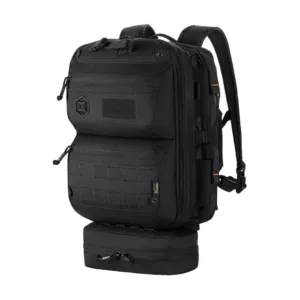
Choose a tactical backpack by volume and back system, not by looks or pattern. Up to 25 liters suits everyday use and day trips, 30 to 45 liters a weekend, and over 50 liters is the choice for multi-day routes or service.
Below are four things worth checking before you buy, and where people most often go wrong.
1. Volume for real-world use
The most common mistake is buying with room to spare. A backpack that is too big always fills up, because there is space for things you did not need to carry. The result is a heavier pack and a tired back.
| Volume | Best for |
|---|---|
| Up to 25 l | City, work, school, day trip |
| 30 to 45 l | Weekend, hike, service kit |
| Over 50 l | Several days outdoors, full gear |
If you are torn between two sizes, choose the smaller one. You can always attach extra items to the MOLLE system on the outside.
2. The MOLLE system and when you really need it
MOLLE is a webbing grid for attaching extra pouches, a bottle holder or a first aid kit. The practical benefit is that you set up the backpack to suit your needs, not the manufacturer's default configuration.
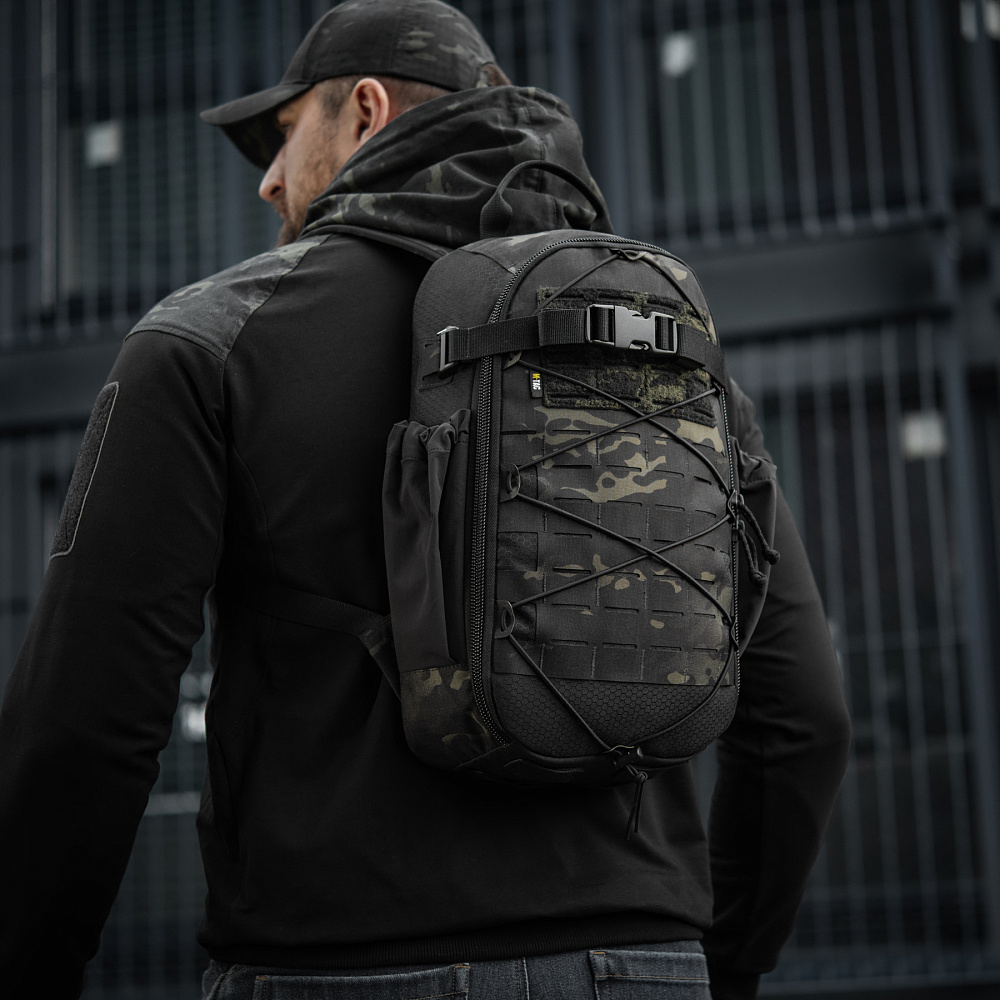
But MOLLE has a cost too. The webbing adds weight and snags if you carry the pack in the city. That is why laser-cut versions appeared, where the attachment slots are cut straight into the fabric. They are lighter and flatter, with almost the same holding capacity.
Choose full MOLLE if you will actually attach extra gear. Choose laser-cut if the backpack will be carried every day and it matters that it does not look too military.
3. Fabric and seams
Tactical backpacks most often use dense polyester or nylon with a water-repellent coating. The number with a D, for example 600D, shows the fabric density. A higher number means a tougher but also heavier fabric.
More important than the fabric itself is what holds it together. Look at the seams at the shoulder straps and the handle, because that is where backpacks tear first. A reinforced manufacturer line, such as M-Tac Elite, differs from the base line precisely in denser fabric and double stitching.
4. Back system and hip belt
This is the most underrated part. From about 30 liters, the weight needs to move from your shoulders to your hips, and that is what the hip belt does. If there is none, or it is just a thin strap, your shoulders will hurt after two hours.
Size is chosen not by height but by back length, from the seventh cervical vertebra to the waist. A ventilated mesh back panel matters in summer, but it holds the weight slightly away from your back, so it is not the best solution for a very heavy pack.
Is a tactical backpack suitable for water sports
Partly. The fabric coating stands up to rain and spray, so the backpack suits the trip to the water and the campsite. But it is not a waterproof backpack. If you paddle a kayak or paddle board and your things must stay truly dry, use a dry bag inside the backpack, or choose a model made specifically for water.
What we offer
We carry M-Tac in Lithuania. The range includes compact Assault Pack models for everyday use, mid-size STURM and Mission Pack backpacks, large Gen.III and Gen.IV Elite models for multi-day routes, and specialized Combat Medic backpacks for first aid gear.
Prices start at 35 EUR for a compact model and go up to 468 EUR for a large Elite line backpack. Made in Ukraine and Poland.
Frequently asked questions
How does the Elite line differ from the base line?
The Elite line uses denser fabric, reinforced seams and sturdier buckle and zipper components. The price is higher, but you feel the difference where the backpack is used every day with a full load.
What backpack volume do I need for a day?
Up to 25 liters. That fits a water bottle, a spare layer of clothing, food for the day and small items. A bigger pack for one day will only fill up with things you do not need.
Is a tactical backpack suitable for everyday city use?
Yes, if you choose a dark single-color version or a laser-cut model. A Multicam pattern and full MOLLE webbing draw attention in the city and give no functional advantage in everyday life.
How do I care for a tactical backpack?
Do not put it in the washing machine, as that breaks down the water-repellent coating. Clean it with lukewarm water and a soft brush, and dry it in the shade. Lubricate the zippers with silicone now and then.
How does a tactical backpack differ from a hiking backpack?
A tactical pack has MOLLE webbing, tougher fabric and reinforced seams, but often less attention is paid to back ventilation. A hiking pack is lighter and more comfortable for long walks, but less modular and less resistant to rough use.
Recommended products
The most popular products in this category