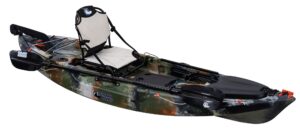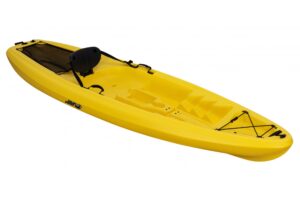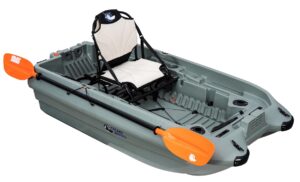
Many Lithuanian anglers start with an inflatable boat. It is familiar, the price does not bite, and the neighbor has one. But what happens after two or three seasons? More and more anglers start looking at kayaks. Not because the boat broke. Because they have realized what they want from fishing, and the boat no longer delivers it.
In this article I have gathered the specific reasons why anglers swap a PVC boat for a kayak. Not theoretical ones, but those that come up again and again on fishing forums and in conversations with anglers who have already made the switch.
"I am tired of assembling and dismantling it"
This is the first and most common reason. Getting a PVC boat ready for fishing takes time and effort. A quality boat with a hard floor and keel: unload it from the car, unfold it, lay the plywood or aluminum floor, inflate the chambers, fit the transom, hang the motor and connect the battery.
Anglers who fish every weekend quickly do the math: over a season they spend 20 to 30 hours just assembling and dismantling the boat. That is a full working week spent not fishing, but pumping and turning bolts.
A kayak comes off the roof and is in the water a minute later. When you get back, you rinse it and lift it back up. That is it. The 20 hours saved over a season go to what we do all this for: fishing.
"I want to reach spots where others do not go"
This is the second reason experienced anglers mention. A PVC boat with a 15 cm draft and a motor simply cannot physically reach many spots: the edges of shallow lakes, river shallows, the margins of reed beds and narrow channels.
A kayak with an 8 to 12 cm draft gets through everywhere. And not only does it get through, it does so quietly. An angler in a kayak can approach the weed beds where pike are holding to within 3 to 5 meters without spooking the fish. In a boat that is impossible.
Fishing portals note that a kayak's advantage in the shallows is one of the main reasons anglers choose one. This is especially relevant on Lithuanian lakes, where there are many shallow, weedy spots, which is exactly where the fish hold.
"The fish can hear me from far away"
The sound factor matters more than many think. A PVC boat generates noise from several sources: motor vibration, a rattling transom, footsteps on a hard floor, oars scraping against the rubber tubes, and squeaking pumps and valves.
In a kayak, the sources of noise are minimal. The paddle rises and falls without touching the hull. The hull is a single piece of plastic with no metal parts that can rattle. Many fishing kayaks also have a tackle hatch through which you can lower a fish finder transducer without an extra bracket that would create vibration.
The result shows in practice. Anglers who switch from a boat to a kayak often notice that their catch rate goes up, especially for pike, trout and salmon. These fish are extremely sensitive to noise.
"A kayak is a fishing tool, not a means of transport"
A PVC boat was designed as a general-purpose craft. It suits a family paddle on a lake, a trip out to an island or a spin with a motor. But it is adapted for fishing only with add-on accessories.
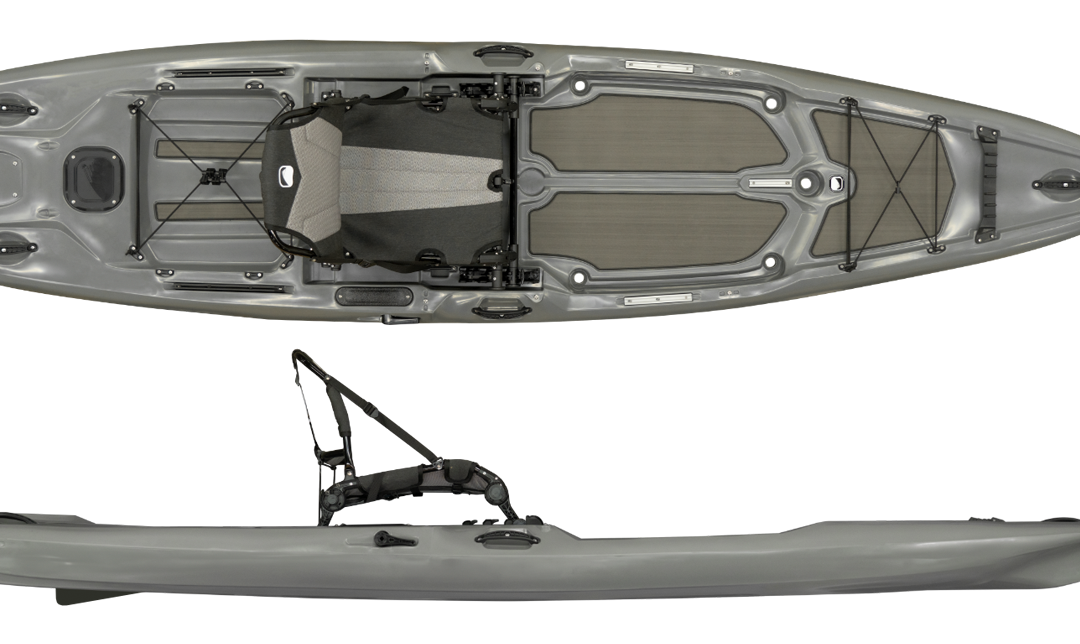
A fishing kayak is designed for fishing from the drawing board up. What this means in practice:
Rod holders are part of the hull. They are integrated so the rods are within reach but do not get in the way of paddling. As standard, 2 to 4 flush-mount holders.
Gear track systems (Railblaza, YakAttack) let you attach extra gear anywhere: a fish finder, a fish locator, a bottle holder, a camera or an extra rod holder. Everything attaches without drilling or glue and can be repositioned in seconds.
The storage compartments (hatches) are sealed. Keys, phone and documents stay dry. In a PVC boat everything lies in the open and gets wet.
The tankwell at the back of the kayak is made for a big load: a cooler, a fish net and extra gear. It is held down with bungee netting and does not move.
The seat in a fishing kayak is adjustable with back support. Sitting in it for 6 to 8 hours is comfortable. A PVC boat's seat is usually a hard bench plank or an inflatable cushion.
"A kayak needs no maintenance"
A PVC boat needs regular care. After every use you have to: rinse it with fresh water (especially if used in salty water), dry it completely before folding (otherwise mold appears and the PVC starts to deteriorate), check the chambers for leaks, sometimes lubricate the valves, store it in winter somewhere the temperature does not drop below zero, and every few years restore the seams and reglue parts that have come unstuck.
A kayak: you rinse it. That is it. Rotomolded polyethylene is not afraid of frost, sun or damp. No need to patch, lubricate, glue or store it specially. You can keep a kayak outdoors under a cover all year round.
"I resold my kayak for half the price after 5 years"
Return on investment is another important factor. A PVC boat wears out, and after 5 years its value drops to 20 to 30 percent of the original price. And that is an optimistic scenario, if the boat was properly looked after.
After 5 years a kayak still looks and works like new (if it was not dragged over rocks). Its resale value reaches 50 to 70 percent. That means your actual fishing costs over 5 years with a kayak are lower than with a PVC boat, even though the kayak's initial price may be higher.
"I like fishing alone"
An inflatable boat is designed for passengers. Even the smallest boats are two-seaters. This means there is always unused space in the boat, and extra weight too.
A single-seat fishing kayak is optimized for one person. Everything is within reach, everything is convenient, there is no excess weight. One person can carry, launch, control and fish from a kayak without any help.
That is the essential freedom: no need to coordinate times with a friend, no need to ask for help with a heavy boat, no need to rush anywhere.
"I switched and I would not go back"
Practically every angler who has switched from a PVC boat to a kayak says the same thing: "Why did I not start sooner?" It is not a marketing slogan but a genuine experience that comes up again and again on forums and in fishing communities.
The only problem is that kayaks are unfamiliar to most Lithuanian anglers. They have seen kayaks on rivers or at sea, but do not know that there are kayaks made specifically for fishing, with all the necessary gear.
Where to start
If you are considering a fishing kayak, start with these questions: where will you fish (lakes, rivers or the sea), will you fish alone or with a partner, and what is your budget.
Budget fishing kayaks: Galaxy Kayaks offers quality kayaks from 600 EUR. A good start for beginners who want to try kayak fishing without a big investment.
Mid-range: Native Watercraft kayaks feature a wide, stable hull that suits both fishing and recreational paddling.
Top end: Bonafide kayaks are among the best fishing kayaks in the world. Wide and stable, with premium-quality seats and gear track systems. NuCanoe offers a unique modular platform you can stand on, attach any gear to and even fit with an electric motor.
If you want to know more about the differences between a PVC boat and a kayak in concrete numbers, read our detailed comparison.
You will find all fishing kayaks and their specifications vakasport.lt.
Where to start
When switching from a boat to a kayak, three things are usually enough.
- Bonafide SS107 wide and stable, suits beginners
- RAILBLAZA Rod Holder R the first accessory worth buying
- Baltic Pro Sailor 100N liemenė
Read also
- Kayak or inflatable boat for fishing: what to choose in 2026
- Inflatable or hard-shell kayak: the differences and who each suits
- Kayak or boat: which to choose for fishing?
Recommended products
The most popular products in this category