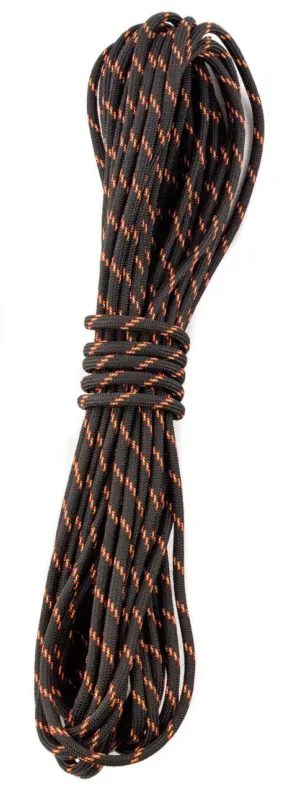

In short: paracord is a light nylon cord made of a braided sheath and inner strands, also called parachute cord. For most camp jobs choose paracord 550, which holds about 250 kg. Thin Minicord (2.2 mm, about 100 kg) is enough for small tie-downs, and for heavy lashing choose PowerCord 1000 (5.5 mm, 450 kg). Paracord is not suitable for holding a person's weight.
| Rope | Diameter | Breaking strength | Core | Best for |
|---|---|---|---|---|
| M-TAC Minicord | 2.2 mm | 100 kg | 3 strands | laces, loops, small tie-downs |
| M-TAC Minicord Reflective | 2mm | 120 kg | 3 strands | tent guylines visible in the dark |
| M-TAC paracord 475 | 3mm | 220 kg | 7 strands | light hikes where weight matters |
| M-TAC paracord 550 Type III | 240 kg | 7 strands | most camp jobs | |
| M-TAC paracord 550 Mil-Spec | 3.6 mm | 270 kg | 9+1 strands | made to MIL-C-5040H |
| M-TAC Survival | 4mm | 240 kg | 7 strands, jute, fishing line | survival kit |
| M-TAC PowerCord 1000 | 5.5 mm | 450 kg | 15 strands | heavier lashing |
| M-TAC Shock Cord | 3mm | 100 kg | elastic core | holding gear down, not paracord |
Breaking strength is the load a cord holds before it breaks. The working load should be several times lower, especially if the cord is jerked, rubs on a sharp edge or is knotted, because a knot weakens the cord.
What is paracord
Paracord was first used for parachute lines in the Second World War, hence the name parachute cord. Soldiers quickly found it useful for almost everything: pitching a tent, tying down gear, even sewing clothes. That is how it moved from the army to camping, fishing and everyday use.
The cord has two parts. The outer sheath is tightly braided from nylon fibres and protects against abrasion. Inside is a core of several strands that carry most of the load. The strands can be pulled out and used separately, for example for sewing or tying small items. Nylon does not rot, dries quickly and stretches a little, so the cord absorbs a jerk well.
What 550 and Type III mean
The number 550 is the breaking strength in pounds: 550 lb is about 250 kg. Type III is a type in the US military specification MIL-C-5040H that defines the cord construction and strength. Exact values differ by manufacturer: M-TAC lists 240 kg for its 550 Type III and 270 kg for its 550 Mil-Spec.
Other numbers work the same way. 475 means about 220 kg and a thinner cord, while PowerCord 1000 holds 450 kg and is noticeably thicker.

550 vs Minicord vs PowerCord
Paracord 550
The classic cord to start with. It handles a tent, a tarp, cargo lashing and most other jobs. If you buy one spool, buy this one. For kayakers there is also the YakAttack 550 reflective paracord, and its 10.7 m length is enough for an anchor trolley.
Minicord
A thin 2.2 mm cord with 3 strands that holds about 100 kg. It is light and takes little space, so it suits laces, zipper pulls, loops and a small tarp. Minicord Reflective has a woven reflective strand, so tent guylines are visible at night and you do not trip over them.

PowerCord 1000
A thick 5.5 mm cord with a 15-strand core that holds 450 kg. Choose it where 550 is too weak: a bigger tarp in the wind, tying a boat or kayak on shore, lashing heavier cargo. It comes in 15 m and 60 m spools.

Other cords
The Survival cord has jute tinder for starting a fire and braided fishing line in its core besides the 7 strands. Dragon Cord has a ribbed braid that slips less in your hands and in knots. Shock Cord is not paracord: it is an elastic cord that stretches and contracts again, so it is handy for holding gear down on a backpack or kayak.

10 paracord uses at camp and on the water
- Pitching a tent or tarp. 550 cord holds a tarp even in wind, and Minicord Reflective works well for tent guylines.
- Drying clothes. A line between two trees turns into a drying rack for wet clothes and towels at camp.
- Hanging food. A food bag hung from a branch stays safe from ants, foxes and other animals.
- Tying a kayak on shore. When camping by the water, tie up your kayak or paddle board so wind or waves do not carry it away. Use 550 or PowerCord.
- Anchor trolley. Paracord is often used for a kayak anchor trolley. We explain how to set one up in our kayak anchoring guide.
- Attaching gear to a backpack. A sleeping pad, pot or shoes are easy to tie to the backpack MOLLE loops.
- Weaving a bracelet. A paracord bracelet is a few metres of spare cord you always carry. A bracelet for an average wrist usually takes about 3 m of cord.
- Spare laces. If a shoelace breaks, a piece of Minicord or 550 replaces it until the end of the trip.
- Small repairs. Strands pulled from the core can sew up a torn backpack or clothing, and the fishing line in the Survival cord even lets you fish.
- Wrapping a knife or tool handle. A wrapped handle grips better, and you always have cord with you. You will find knives and multitools in a separate category.
How to choose paracord
First think about what you will use it for. If you are not sure, take 550: it suits most jobs. If the cord is for small tie-downs and weight matters, choose Minicord. If you need to hold a heavy load, choose PowerCord 1000.
Length depends on use. A 15 m spool is enough for a backpack and everyday jobs, 30 m is worth it for camp with a tarp, and if you use cord all the time a 60 m or longer spool pays off. All cords are in our paracord category.
Planning a multi-day trip? Our guide to multi-day kayak trips has the full packing list.
Safety note
Paracord is not a climbing rope. It is not suitable for holding a person's weight, climbing, fall protection or rescue. Certified dynamic or static ropes are used for that. Do not tow a car or boat with paracord, because a tensioned cord that snaps can cause injury.
Frequently asked questions
How much does paracord 550 hold?
Paracord 550 has a breaking strength of 550 lb, about 250 kg. M-TAC lists 240 kg for 550 Type III and 270 kg for 550 Mil-Spec. That is breaking strength, so the working load should be several times lower.
What is the difference between paracord and parachute cord?
None. Paracord is short for parachute cord. In Lithuanian it is also called parašiutinė virvė or parakordas.
What is the difference between Minicord and paracord 550?
Minicord is thinner (2.2 mm), has 3 strands and holds about 100 kg. Paracord 550 has 7 or more strands and holds about 250 kg. Minicord suits small tie-downs, 550 most camp jobs.
How much paracord do you need for a bracelet?
A bracelet for an average wrist usually takes about 3 m of cord. A wider weave or thicker bracelet needs more, so a 15 m spool is worth buying.
Is paracord suitable for climbing?
No. Paracord is not suitable for holding a person's weight, climbing or fall protection. Certified climbing ropes are used for that.
Recommended products
The most popular products in this category