An inflatable boat is probably the first craft an angler thinks of when they want to get off the shore. The price is affordable, it fits in the trunk, you pump it up and off you go. But today's "rubber boats" have long since stopped being made of rubber. The vast majority of boats you will find in stores are made of PVC fabric. In this guide I explain what you need to know before buying, so you do not overpay or end up regretting it.
First things first: PVC, not rubber
The term "rubber boat" comes from Soviet times, when boats really were glued together from rubberized fabric. Those boats were heavy, smelled and cracked within a few years.
Modern inflatable boats are made of reinforced PVC fabric. It is a polyester or nylon scrim (mesh) coated on both sides with a layer of PVC. This material is lighter, stronger and more UV-resistant than the old rubber.
There is also a more expensive alternative: Hypalon. It is a synthetic rubber that is even more resistant to temperature swings and sun, but Hypalon boats cost several times more than PVC ones. You will practically not find Hypalon boats on the Lithuanian market unless you order from abroad.
"Five layers" and other myths
One of the most widespread myths in the boat market: "our boat is made of five-layer PVC, while competitors' are only three". As the fishing portal zvejams.lt writes, this is a pure marketing trick. The structure of reinforced PVC is the same everywhere: a PVC film, a scrim (fabric), a PVC film. Some manufacturers count the glue layer between the components as "layers" and so "increase" the number.
It is more accurate to call boat material reinforced PVC and to look not at the number of layers but at the actual material density and the manufacturer's certificate.
Material density: is higher better?
Not always. The most popular European PVC materials (Valmex from Germany, Mehler, Finnish TRW) have a density of about 850 g/m². Korean and Chinese PVC is often 1,100 g/m². Does that mean the Asian fabric is stronger?
Not necessarily. As fishing experts point out, European 850 g/m² and Asian 1,100 g/m² materials have similar tensile, tear and puncture characteristics. The difference is that the denser fabric weighs more, so the whole boat will be heavier.
When choosing a fishing boat, what matters is not the material density but whether the material is certified specifically for making inflatable boats. Some manufacturers use cheaper PVC meant for awnings or pools. Such products are short-lived and can be unsafe.
A practical tip: the material density of a boat suitable for fishing is usually 850 to 1,100 g/m². If the boat will be kept outdoors by the water for long periods, it is better to choose a denser material. If you will carry it by car and keep it in a garage, 850 g/m² is quite enough.
Seams: welded or glued?
Another popular question. The short answer: both technologies are equally reliable if done well.
Welding is done by an automatic machine at high temperature. The advantage: a faster process and less chance of human error. The drawback: if the machine is not set up properly, it can burn through the material.
Gluing is done by hand with an industrial heat gun and special PVC glue. The advantage: experienced craftsmen can achieve a perfect result. The drawback: it depends more on the human factor.
Well-made seams, whichever method is used, will hold for decades. If a seam has a defect, it will show the first time the boat is inflated, not after a few seasons.
Floor types: what comfort depends on
Choosing the floor is one of the most important decisions, especially if you will use the boat for fishing. Do not cut corners here.
Inflatable floor (Air Deck). The lightest and simplest option. A boat with this floor is the quickest to assemble. However, the floor is not completely rigid, and it is harder to stand on. Suitable for recreational boating on calm water.
Folding floor (slat floor, roll-up). Made of aluminum or plywood slats. The standard option for many boats. Firmer than an air deck, but not as firm as a full floor.
Hard floor (plywood or aluminum). Plywood or aluminum panels run the full length of the boat. This is the sturdiest option: you can stand with confidence, the floor holds its shape well and the boat runs more steadily. This is exactly the type recommended for fishing. However, a boat with this floor weighs 10 kg or more than one with an air deck, and takes longer to assemble.
The same logic applies to inflatable fishing kayaks: NRS Pike the floor is made with drop-stitch technology, so when inflated it is as firm as a board and you can stand on it.
For spin fishing a hard floor is practically essential. As fishing enthusiasts note on forums: there will be wet and sharp items in the boat (crankbaits, spoons, treble hooks), and on a soft floor they can puncture the chambers.
Shapes and keel
A flat-bottomed boat has no keel. It is stable when standing but holds its course poorly and is harder to control in waves and with a motor. Suitable for short trips on a calm lake.
A V-shaped hull with a keel is the anglers' most popular choice. The keel (inflatable or rigid) gives the boat directional stability, steadiness in waves and better running with a motor.
A deep V hull is made for larger bodies of water and stronger wind. These boats cost more, but they are the most stable.
Size and capacity
The most popular PVC boat categories for fishing:
For fishing alone: a boat length of 2.4 to 3.0 m. Enough room for one angler with gear. Easy for one person to carry and assemble.
For fishing as a pair: a boat length of 3.0 to 3.6 m. The most comfortable category for two anglers. Popular models: Kolibri KM-330 (330 cm, 4 seats, 480 kg capacity, about 31 kg with an air deck).
For three or more: a boat length from 3.6 m. These boats are already heavy (50 kg or more) and need a trailer or at least two people to carry. Better with a motor.
Motors
Inflatable boats are designed with a transom at the back, to which the motor is attached.
The general rule: boats up to 3 m long suit motors up to 5 HP (horsepower). Boats up to 3.5 m, up to 15 HP. 4 m boats, 15 to 20 HP.
Electric motors are a quieter and cheaper alternative, but they need a heavy battery and their run time is limited. We sell electric trolling motorsmade for kayaks, so they will suit a PVC boat only if you have a suitable mounting point.
Important: in Lithuania, motorized navigation must follow inland waterway rules. On some lakes motorboats are prohibited or restricted.
The most popular manufacturers in Lithuania
Kolibri is probably the most popular boat manufacturer on the Lithuanian and Baltic market. A Ukrainian company using German Valmex PVC fabric. It has a wide range of models, from small rowing boats to large motorboats. Most are sold with a 3-year warranty.
Bark is another Ukrainian manufacturer, popular with budget-conscious anglers. A simpler construction, but reliable materials.
Aqua Storm offers mid-priced boats with good reviews.
Intex and Bestway are budget options you will find on Pigu.lt or Senukai.lt. These are recreational boats made of thinner PVC, without a hard floor. They are only of very limited use for fishing. If you plan to fish regularly, it is better to invest in a quality boat or consider another craft.
Price guide for 2026
Cheap recreational boats (Intex, Bestway): 25 to 100 EUR. Fine for children on the beach. Not suitable for fishing.
Budget PVC boats without a hard floor: 150 to 350 EUR. The first "more serious" option, but stability is limited.
Mid-range boats with a hard floor (Kolibri KM-260 to KM-330): 400 to 800 EUR. The best choice for fishing. In this price band you get a keel, a hard floor and a proper transom for a motor.
Higher-end motorboats (from 3.6 m): 800 to 1,500 EUR and more. Large, heavy, need a trailer.
On top of the boat price, add a pump (30 to 60 EUR), oars (often included) and, if you plan to use a motor, the motor price (electric from 150 EUR, petrol from 500 EUR). If the included oars are too short or break, you will find a replacement among our paddles.
Before you buy: what to consider
A PVC boat is a good choice if you need an inexpensive craft that fits in your car. But before buying, think about a few things.
Assembly time: you will assemble a quality boat with a hard floor in 20 to 30 minutes. Dismantling takes about as long. Add an hour to every fishing trip just for getting ready and packing up.
Storage: PVC must not be kept folded in the cold for long periods, as the material can crack at the folds. Ideally store it half-inflated or in a storeroom where the temperature does not drop below zero.
Durability: a properly maintained PVC boat lasts 5 to 10 years. But UV, petrol and mechanical damage shorten that time.
Fishing comfort: a PVC boat is designed for boating, not fishing. A spin angler will need extra solutions: rod and fish finder mounts and an anchor system. All of this is bought separately.
An alternative worth considering
If you see a fishing boat as an investment rather than a one-off purchase, it is worth comparing a PVC boat with another option: a fishing kayak.
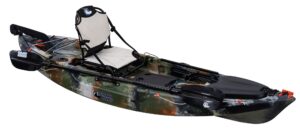
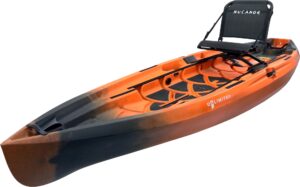
A sit-on-top fishing kayak costs about the same as a quality PVC boat with a hard floor (for example, the Galaxy Kayaks Blaze XL costs 499 EUR), but offers several key advantages: there is nothing to inflate or assemble, it has integrated rod holders and storage, the kayak is faster and glides more quietly, and the rotomolded plastic hull lasts 15 to 20 years or more.
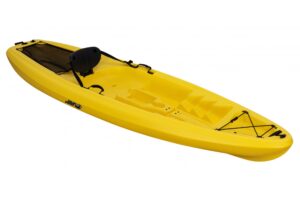
If your budget is closer to the price of a simple PVC boat, our cheapest sit-on-top kayak is the Galaxy Reef Adult. It weighs 18.5 kg, the paddle is included, and for fishing you just need to add a rod holder.
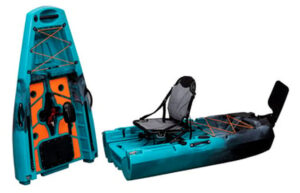
If it still matters that the craft fits in your trunk, there is a middle option: NRS Kuda an inflatable fishing kayak that folds like a boat but has a firm drop-stitch floor and fishing-ready equipment.

We write in more detail about the differences between kayaks and inflatable boats in the article Kayak or inflatable boat for fishing: what to choose in 2026.
What is worth having in the boat
An inflatable boat without accessories is half a kit. These things will come in handy from the first outing.
- Baltic Pro Sailor 100N life jacket required by the rules, comfortable all day
- NRS Expedition DriDuffel dry bag your phone and documents stay dry
- RAILBLAZA Rod Holder R rod holder hands free while paddling
We do not sell inflatable boats, but if you are considering an alternative, you will find the full fishing kayak range in our catalog.
Recommended products
The most popular products in this category