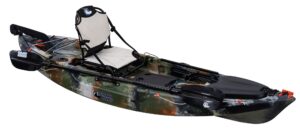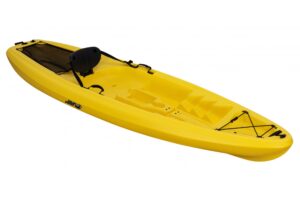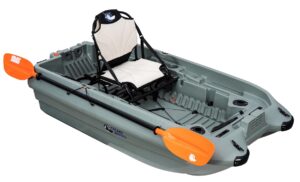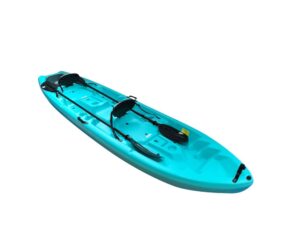
You have bought a fishing kayak. Now you need to rig it. A standard kayak out of the box is just a platform. It becomes a real fishing kayak once it has room for rods, a fish finder, tackle boxes and an anchor. In this guide we show you step by step how to rig a kayak for serious fishing.
Rod holders: the foundation
The first and most important accessory is rod holders. They let you have several rods rigged at once, change lures quickly and avoid risking your tackle at the water's surface.
There are two main types. Vertical flush-mount holders are mounted directly into the kayak hull and hold the rod vertically. They suit transport or trolling. Adjustable holders (such as the Railblaza Rod Holder II or YakAttack Omega Pro) let you change the angle and are more versatile.
We recommend having at least 3 rod holders: two behind you (for transport and trolling) and one to the side (for active fishing). If the kayak has integrated Railblaza StarPort or Track Rail systems, installation takes a few minutes with no drilling at all.
In the VAKA Sport accessories section you will find Railblaza rod holders with various mounting options. The Railblaza system is modular: one StarPort base accepts a rod holder, a flag, a camera or a light.
The Track Rail system: a universal solution
A Track Rail (or Gear Track) is an aluminum rail mounted on the side of the kayak that lets you attach any accessory in any position. YakAttack GearTrac and Railblaza StarPort TracMount are the most popular options, and accessories attach to the track via the YakAttack LockNLoad track base.
The advantage of Track Rail is flexibility. One day you can have a rod holder at the front, the next day a fish finder mount in the same spot. Accessories slide or twist into the track and lock with one hand.
Installation requires drilling into the kayak hull. Before drilling, mark the spots, check that there are no internal walls under the hull, and use marine sealant around every bolt. This stops water getting inside the kayak.
Fish finder: installation and choosing the spot
A fish finder is a must-have tool for a serious kayak angler. It shows bottom structure, depth, water temperature and where fish are holding. The most popular models for kayak fishing are the Garmin Striker and Lowrance Hook series, thanks to their compact size and affordable price.
A fish finder has three parts: the screen with its mount, the transducer and the battery. The screen is mounted in front of you, ideally on a Track Rail system. YakAttack LockNLoad fish finder screen mount and the Railblaza Adjustable Platform are made for exactly this.
The transducer can be mounted in several ways. The simplest is scupper hole mounting, where the transducer is simply passed through a drain hole in the kayak's bottom. Another option is mounting on a bracket at the back of the kayak (transom mount). Keep the battery (usually 12V 7 to 9Ah) in a dry spot, often the front or rear hatch.
Anchor system and anchor trolley
An anchor system lets you hold the kayak in one spot. This is especially important when fishing rivers with current or lakes with wind. Without an anchor the wind pushes the kayak and you spend more time positioning than fishing.
An anchor trolley is a rope system that runs along the side of the kayak from bow to stern. It lets you change the anchor attachment point without getting up from the seat. This controls how the kayak sits against the wind or current. If the anchor line is attached at the front, the kayak sits bow into the current. If at the back, the kayak swings stern first.
An alternative to an anchor is a stakeout pole. It suits shallow water up to 2 meters deep. You simply push the pole into the bottom and the kayak stays in place. The YakAttack ParkNPole is the most popular option. It is silent, quick to use and great for fishing shallows.
Storing lures and gear
Order on a kayak is not a luxury but a necessity. Lures, worm boxes and tools scattered around mean time lost searching for the right item.
Use closed containers for lures. Soft tackle bags are better than hard boxes, because they do not slide and fit kayak hatches better. Keep a separate box for your most-used lures that you can reach without getting up.
The milk crate system is a classic kayak angler's solution. It is a plastic crate fixed to the kayak's rear platform that holds rod holders, tackle boxes and other accessories in one compact unit. You can buy a ready-made one or build your own from a standard milk crate.
Safety gear
The last but no less important step is safety gear. A life jacket is always mandatory. Special fishing vests with pockets and a high back that does not get in the way when sitting in a kayak seat suit fishing well. NRS Chinook OS Fishing PFD is made specifically for kayak anglers, while WALLYS vests stand out for Scandinavian durability and a wide choice of models. Baltic Lifejackets also offers models for active water sports.
Extra safety gear: a whistle, a knife (attached to your vest), a first aid kit and a waterproof phone case. If you fish alone or far from shore, carry a light signal or a mirror.
Rigging checklist: what to have before your first fishing trip
Must-have accessories: a life vest, at least 2 rod holders, an anchor system or stakeout pole, a tackle box and a whistle.
Highly recommended: a fish finder, a Track Rail system, an anchor trolley, a kayak cart for transport and a dry bag for your belongings.
For experienced anglers: navigation lights (mandatory after dark), a camera mount, extra rod holders, and a Power Pole-type shallow water anchoring system.
Start with the must-have accessories and add extras as needed. You do not need to invest in everything at once. The Railblaza modular system lets you start with one StarPort mount and expand as needed, as all the accessories are compatible with each other.
Read also
- TOP 10 kayak modifications for fishing: from holders to electronics
- Fish finder on a kayak: how to choose, mount and use one (2026)
- Kayak transport and storage: everything you need to know before you buy
Frequently asked questions
How many rod holders does a fishing kayak need?
We recommend at least 3: two behind you for carrying rods and trolling, and one to the side for active fishing.
Do you need to drill holes to mount accessories on a kayak?
Not always. Railblaza offers adhesive and clip-on options. However, Track Rail tracks and flush-mount holders usually require drilling with marine sealant.
Which fish finder should I choose for a kayak?
The most popular for kayak fishing are the Garmin Striker and Lowrance Hook series, thanks to their compact size and affordable price. They show depth, bottom structure and fish marks.
Recommended products
The most popular products in this category