
In short: a SUP paddle should be about 15 to 25 cm longer than your height, with a blade of 580 to 650 cm² and a shaft of aluminium, fibreglass or carbon depending on how much you paddle. A beginner is fine with an adjustable aluminium paddle; if you paddle every week, fibreglass or carbon is worth it because it is lighter and easier on the shoulders.
| Your paddle | Shaft | Weight | Price | Best for |
|---|---|---|---|---|
| Galaxy Kayaks SUP paddle 170–210 cm | aluminium, 3 piece | about 900 g | 34.99 EUR | Beginners, families |
| NRS PTS | aluminium, 2 piece | not stated | 99 EUR | A tough everyday paddle |
| NRS Bia 95 Adjustable | fibreglass | 822 grams | 149 EUR | Leisure, regular paddling |
| NRS Fortuna 90 Adjustable | carbon reinforced | 590g | 150 EUR | Fitness and touring |
| Braca-Sport Stand Up Kahana | 100% carbon fibre | 445–490g | 424.99 EUR | Experienced paddlers, long distances |
Prices in the table update automatically from the shop prices.
What length SUP paddle do I need?
The usual rule: your height plus 15 to 25 cm. If you are 175 cm tall, the paddle should be 190 to 200 cm. For relaxed paddling and touring choose the longer end, because you stand upright and the paddle reaches further. For waves or a fast pace a shorter paddle works better, because the strokes are quicker and lower.
The simplest check on shore: stand the paddle next to you and raise your arm. Your wrist should rest comfortably on the handle. If the paddle is too long your shoulders tire; if it is too short you bend forward and your back hurts.
If several people use the board, choose an adjustable paddle. Almost all the SUP paddles we sell are adjustable, usually within 170 to 213 cm, so one paddle suits both a 160 cm and a 190 cm paddler.
Aluminium, fibreglass or carbon?
The shaft material decides weight and stiffness. The lighter the paddle, the less you tire in an hour of paddling, because you lift it hundreds of times.
- Aluminium: the cheapest and toughest, but the heaviest at about 900 g and more. It does not mind rocks or hitting the bottom. A good first paddle, and usually the one that comes with a board set.
- Fibreglass: about 800 g, stiffer and nicer in the hand. The best balance for people who paddle every week.
- Carbon fiber: 450 to 600 g, the stiffest, so every stroke delivers more power. The most expensive and more sensitive to knocks against rocks.
The blade is usually plastic or reinforced nylon, carbon on premium paddles. A plastic blade lasts longer in shallow, rocky places.

What blade size is best?
Blade area is measured in square centimetres. A smaller blade, 560 to 600 cm², needs less force per stroke, so it suits lighter paddlers, women, teenagers and long distances. A bigger blade, 620 to 650 cm², gives more power at once, so heavier and stronger paddlers choose it, or those who want stability in waves.
For example, the NRS Fortuna 90 has a 581 cm² blade and suits a high stroke rate, while the 648 cm² blade of the Braca-Sport Kahana adds stability through the whole stroke. For most beginners a middle size of about 600 cm² is a safe choice.
Two piece or three piece paddle?
A three piece paddle fits in the board backpack, so the whole set travels in one place. A two piece paddle is slightly stiffer because it has one joint fewer. If you carry the board by car and only short distances, two pieces are enough. If you travel by train, plane or bike, choose three pieces: the NRS Bia 95 Travel, for example, is no longer than 94 cm when taken apart.
Pay attention to the joint type. A pin joint fixes the length in a few positions, while a lever joint such as the NRS LeverLock sets any length with one move. The lever is handier when several people share the paddle.
Does a SUP paddle float?
Most aluminium and fibreglass paddles float, but not all of them and not for long, especially if water gets into the shaft. A dropped paddle drifts away on a windy day faster than you can hand paddle after it. So on a lake or at sea use a paddle leash. It costs a few euros and clips to the paddle and the board.
- Galaxy Kayaks paddle leash 1.5 m: elastic, 62 g, attaches to a D ring.
- NRS Coil Paddle Leash: coiled, shrinks to 46 cm and does not tangle under your feet.
How do you look after a SUP paddle?
After paddling at sea, rinse with fresh water, especially the joint, otherwise salt and sand jam it. Do not overtighten an adjustable paddle and do not keep it assembled all season: once a month take it apart and dry it. In winter store it indoors, not outside or in the car, because carbon does not like cold or knocks when frozen.
We cover winter storage of all your gear in a separate guide:
Which paddle should you choose by experience?
- First season: an adjustable aluminium paddle such as the Galaxy Kayaks 170–210 cm or the NRS PTS. Cheap, tough, suits the whole family.
- You paddle every week: the fibreglass NRS Bia 95 or the lighter Fortuna 90. You will feel the difference in the first hour.
- Long distances or training: the carbon Braca-Sport Kahana. Made in Lithuania, weighs under half a kilogram.
If you are still choosing the board itself, start with our board buying guide, and you will find all paddles in the paddles category. If you are unsure about the length, write to us with your height and where you will paddle, and we will advise.
Frequently asked questions
What length SUP paddle should I choose?
Your height plus 15 to 25 cm. Longer for relaxed paddling and touring, shorter for waves and a fast pace. If several people use the paddle, choose an adjustable one.
Is a carbon paddle worth the money?
Yes, if you paddle every week or cover long distances. A carbon paddle weighs almost half as much as an aluminium one, so your shoulders tire much later. For a first season aluminium is enough.
How is a SUP paddle different from a kayak paddle?
A SUP paddle has one blade and a T handle and is used standing. A kayak paddle has two blades and is shorter, and is used sitting. One does not replace the other.
Does a SUP paddle float?
Most aluminium and fibreglass paddles float, but not for long if water gets into the shaft. On a lake or at sea use a paddle leash.
Does a paddle come with the board?
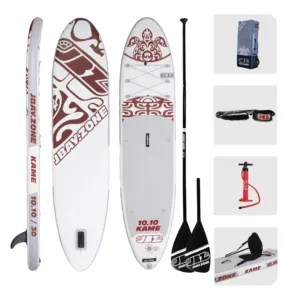
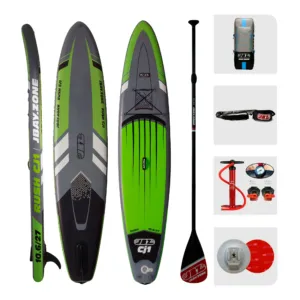
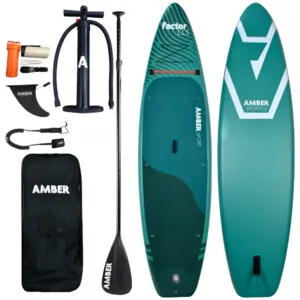
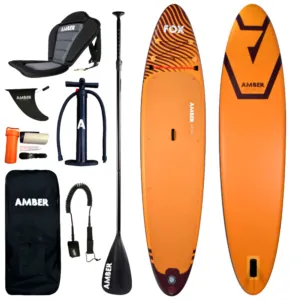
Yes, almost all inflatable SUP sets include an adjustable aluminium paddle. It is worth buying a paddle separately when you want a lighter fibreglass or carbon option.
What blade suits a beginner?
A medium one, about 600 cm². A smaller blade suits lighter paddlers and long distances, a bigger one stronger paddlers and waves.
Recommended products
The most popular products in this category