Inflatable kayaks have taken a huge leap in quality in recent years. They are no longer flimsy toys but serious water sports gear used by experienced anglers and tourers alike. The main advantage is obvious: the whole kayak fits in a backpack or a car boot. But can an inflatable kayak really compete with a hardshell? We explain who it suits and who it does not.
Read also: How to choose a kayak, Kayak touring.
What are the advantages of an inflatable kayak?
Compactness. This is the main argument. A folded inflatable kayak fits in a bag measuring 80x40x30 cm. You need neither a roof rack nor a garage to store it. On an apartment balcony or in a wardrobe it takes up as much space as an average sports backpack.
Weight. Most inflatable kayaks weigh 10 to 18 kg, while a hardshell kayak weighs 20 to 40 kg. One person can easily carry an inflatable kayak to the water, even through a forest or along a long path.
Stability. Inflatable kayaks are usually wider than hardshells, so they are very stable. That is a big plus for beginners, as it is hard to fall off a kayak like this.
Impact resistance. Contrary to what you might expect, quality inflatable kayaks are very tough. High pressure PVC or Hypalon will take knocks against rocks, branches and riverbanks without any damage.
What are the drawbacks?
Speed. An inflatable kayak is slower than a hardshell. The wider shape and softer hull mean more drag in the water. If you plan long distances or racing, a hardshell kayak will be more efficient.
Tracking. Without a fin, an inflatable kayak is more affected by wind and current. Most models have a removable fin that helps, but it still will not match the precision of a hardshell.
Setup time. It takes 5 to 10 minutes to inflate and about the same to deflate and pack. With a hardshell you just take it off the roof and paddle.
Durability. A hardshell HDPE kayak lasts 15 to 20 years with almost no maintenance. An inflatable, even a quality one, has a shorter lifespan (5 to 10 years depending on use) and needs a little more care: dry it before packing and keep it out of direct sunlight.
Who is an inflatable kayak best for?
An inflatable kayak is the ideal choice if:
- You have no space to store a hardshell kayak (you live in a flat)
- You do not have a roof rack on your car
- You want to take the kayak on a plane or a bus
- You paddle on calm lakes and slow rivers
- You are looking for an easy option for family holidays
- You are planning hikes with a backpack plus river paddling (in that case look at packrafts)
If fishing is your main goal, there are also excellent inflatable fishing kayaks with built in rod holders and stability systems.
Who is better off with a hardshell kayak?
A hardshell kayak still has the edge in these situations:
- Fishing on fast rivers or at sea, where you need maximum stability and toughness
- Long trips (30+ km a day), where speed and tracking become critical
- If you have a garage and a roof rack, storage and transport are not an issue
- Professional use or racing
In our shop you will find a wide range of hardshell kayaks from recreational to professional fishing models.
The best inflatable kayaks of 2026
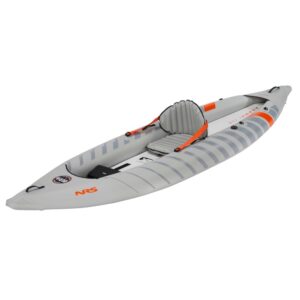
NRS Akamai series (leisure and touring)
NRS The Akamai is one of the best inflatable kayak series on the market. Made from PVC with welded (not glued) seams, which makes it very durable. The series has three models:
- Akamai 110 (335 cm, 12 kg) is a compact single seater, ideal for day trips
- Akamai 125 (381 cm, 14 kg) is a longer model with more storage space, suitable for overnight trips
- Akamai 145 (442 cm, 18 kg) is a tandem model for two people, or for one with a lot of gear
All Akamai models have a high pressure floor that gives a feel close to a hardshell kayak. We cover them in more detail in our NRS inflatable kayak review.
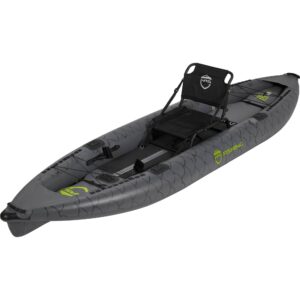
NRS Pike (fishing)
The Pike is the only inflatable kayak in the NRS line built specifically for fishing. It has a wide platform, built in rod holder bases and enough stability to stand up. 340 cm long, 15 kg, with a load capacity of up to 181 kg. A serious alternative to a hardshell fishing kayak if storage space is limited.
Packrafts (ultralight segment)
If you are looking for the lightest option of all, packrafts weigh 3 to 8 kg and fit in a small backpack. They are made for short paddles on rivers and lakes and are often combined with hiking. The trade off is comfort and speed, but for portability they are unbeatable.
Most popular inflatable kayaks
What to look for when choosing
- Material: PVC is the cheapest and suits most people. Hypalon is more UV resistant and lasts longer, but costs more. Avoid cheap single layer PVC kayaks sold in supermarkets.
- Seams: welded seams are stronger than glued ones. This is one of the main signs of quality.
- Pressure: the higher the working pressure (PSI), the stiffer the floor and the better the handling. NRS uses up to 8 PSI, cheaper models only 1 to 2 PSI.
- Seat: check that the seat is adjustable and sturdy enough for longer paddles.
- What's included: are a paddle, pump and carry bag included in the price? Quality manufacturers usually include everything.
Frequently asked questions
Safety on the water
Always wear a life jacketwhen kayaking. For recreational paddling, light and comfortable WALLYS buoyancy aids are a great choice: they do not restrict movement and are affordable. We offer sizes for children and adults based on body weight. More about safety gear: life jacket comparison.
Can an inflatable kayak get punctured?
In theory yes, but in practice quality inflatable kayaks are very tough. NRS and manufacturers of a similar level use multi layer PVC that will withstand contact with rocks and branches. Even if damage does occur, most models have several separate air chambers, so the kayak will not sink even with one chamber damaged.
How long does it take to inflate?
With a hand pump (included) it takes 5 to 10 minutes. With an electric pump (sold separately) 2 to 3 minutes. Deflating and packing takes about the same. In total, it is about 15 minutes from the car boot to the water.
Can you fish from an inflatable kayak?
Yes. Models built specifically for fishing, such as the NRS Pike, have built in rod holder bases and enough stability for active fishing. On calm water an inflatable fishing kayak works perfectly. On fast rivers or at sea it is better to choose a hardshell fishing kayak for its greater stability and toughness.
Recommended products
The most popular products in this category