Every summer thousands of Lithuanians rent canoes and head off on river trips. But if you paddle more than once a season, your own kayak not only pays for itself, it also gives you the freedom to choose your route, timing and pace with no restrictions. Here is a practical guide to planning a multi day kayak trip on Lithuanian rivers.
Read also: Where to kayak in Lithuania, How to choose a kayak.
Why your own kayak and not a rental?
Rental points offer simplicity: you turn up, get a canoe and hand it back at the end. But there are a few serious drawbacks. First, rental canoes are usually old, heavy and uncomfortable. Second, you are tied to specific routes and times. Third, a day's rental costs 30 to 50 EUR, which adds up to 150 to 300 EUR or more over a season.
A recreational kayak costs from 250 EUR and lasts for years. That means your kayak pays for itself by the second season. And the difference in quality between a rental canoe and your own kayak is huge: a more comfortable seat, a more stable hull and less weight.
If you do not have a kayak yet and want one for touring, see our recreational kayaks category or guide to choosing your first kayak.
How do you choose a route?
Lithuania has dozens of rivers suitable for kayak touring. When choosing a route, pay attention to three things: the strength of the current, the distance and whether there are campsites.
For beginners (first overnight trip): The Žeimena or the Šventoji. Gentle current, easy to navigate, with campsites along the banks. A route of 15 to 25 km a day is a comfortable pace. You will find more spots in our guide Where to kayak in Lithuania.
Intermediate (you have some experience): The Minija, the Neris from Vilnius, the Jūra. These rivers are longer and more varied. In some places you may have to portage kayak around a dam or a fallen tree.
For experienced anglers: The Dubysa, the Neris to Kaunas (100+ km), the Ūla in Dzūkija. These need boat handling skills and experience of camping in the wild.
What kind of kayak do you need for a trip?
Any kayak will do for a day paddle. But for an overnight trip you need to think about storage capacity, comfort and efficiency.
A hardshell touring kayak is the best choice for long trips. A longer hull (380 to 450 cm) tracks better, and sealed hatches let you carry your gear safely. The Wilderness Systems TSUNAMI series is one of the best touring kayaks in this segment.
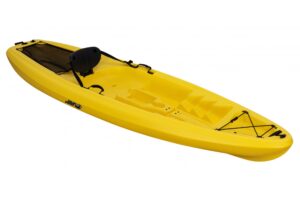
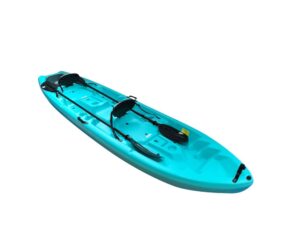
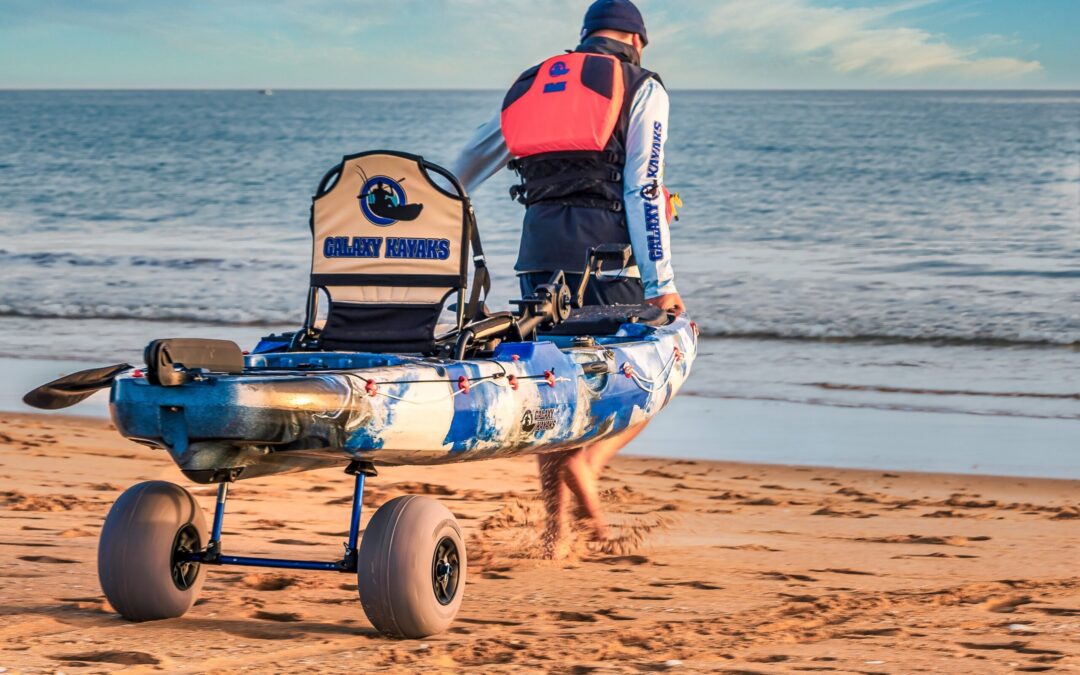
Sit-on-top kayak also work if they have gear attachment points. Galaxy Kayaks models with storage compartments are a popular choice, as they are stable and easy to get out of when you make camp.
Inflatable kayak is a great option if you do not want to carry a hardshell kayak on the roof. NRS Akamai 125 or the larger 145 model has enough space for an overnight trip.
Packraft is the lightest option if you are planning a combined hiking and paddling trip. Packrafts weighs from 3 kg and fits in a backpack.
What gear should you take?
An overnight trip needs more than just a kayak and a paddle. Here is the basic list:
Essential:
- A life jacket : mandatory under Lithuanian law
- Watertight bag (at least 20L): for documents, your phone and a dry change of clothes
- A tent and sleeping bag (packed in a dry bag)
- Food and water (allow 2 to 3 litres of water per person per day)
- Suitable clothing : you need protection from wind and UV even in summer
Recommended:
- A second paddle or a spare paddle blade
- A first aid kit
- Rope (10 to 15 m): for towing the kayak, hanging things up and fixing gear
- A torch (waterproof)
- A map or GPS (a phone battery will not last several days)
- A camping stove and pot
For more on accessories and accessories, read our accessories guide.
How do you organise transport?
The biggest logistical challenge on a multi day trip is that you finish somewhere other than where you started. There are a few solutions:
- Two cars: leave one at the finish and drive the other to the start. After the trip, go back and collect the first car.
- Local rental services: many canoe rental points offer a shuttle service. For 20 to 50 EUR they will drive you back to the start or bring your kayak back.
- Public transport: some routes (for example the Neris from Vilnius to Kaunas) link towns with good public transport. But taking a kayak on a bus is tricky unless it is an inflatable.
- Loop route: on lakes you can plan a loop and come back to where you started.
Safety rules
Kayak touring in Lithuania is safe, but a few rules are a must:
- Always wear your life jacket, do not just keep it next to you
- Do not paddle alone, especially on unfamiliar rivers
- Check the weather forecast. A storm on the water is dangerous
- Tell someone your route and when you plan to be back
- In national parks, camp only in designated places
- Do not leave litter. What comes with you leaves with you
For more on safety and choosing life saving equipment, read our safety gear comparison.
Recommended kayaks for touring
For touring we recommend the Galaxy Kayaks Cruz Ultra (from 599 EUR) or the lighter option, the Galaxy Kayaks Force. When planning longer trips, do not forget dry bags to keep your things protected.
Frequently asked questions
How much does a kayak trip on a Lithuanian river cost?
If you have your own kayak, the cost of a trip is the campsite fee (0 to 10 EUR a night, depending on the place) and food. If you rent, a day's canoe rental costs 30 to 50 EUR, plus another 20 to 50 EUR for transport back. Your own kayak pays for itself after just 2 to 3 trips a season.
Can you paddle on all Lithuanian rivers?
Most Lithuanian rivers are freely accessible. However, restrictions may apply in national parks: paddling on some rivers is banned at certain times of year (during the bird nesting season). Before paddling in a national park, check the park rules.
Which kayak is easiest to carry on a car roof?
The easiest option is an inflatable kayak that fits in the boot. A hardshell kayak needs a roof rack with kayak carriers or foam pads. Shorter kayaks (up to 300 cm) fit more easily on the roof of a smaller car. If transport is your main concern, consider an inflatable kayak or packraft.
Recommended products
The most popular products in this category