Fishing from a kayak almost always comes down to the same question: how do you stay put where the fish are biting? Wind pushes a kayak off in a few minutes, and current does it even faster. An anchor is the cheapest solution, but it is also the only kayak accessory that can flip you if used incorrectly. This guide explains how an anchor trolley works, what anchor weight you need in Lithuanian waters, and where the line is between convenience and real danger.
When a kayak really needs an anchor
You do not always need an anchor. If you are paddling and casting on the move, it will only get in the way. An anchor is needed in four cases.
- The drift is too strong. From as little as 3 m/s of wind, a sit-on-top kayak with a high seat drifts faster than you can cast. The kayak acts like a sail, because both you and the seat stick up above the water.
- You have found structure. A hole, a pile of rocks, a weed edge, a sunken tree. Spots like these need to be fished several times from the same position.
- Current. On the Nemunas, the Neris, the Minija or the Curonian Lagoon, the current runs constantly, even when there is no wind.
- A longer stop. Lunch, retying a rig, changing fish finder settings. Without an anchor, you will drift a hundred meters in ten minutes.
In shallow water up to about a meter and a half, a stakeout pole pushed into the bottom, or simply hooking onto a weed edge, is often enough. In deeper water you need a real anchor.
The anchor trolley: why the kayak's position depends on the tie-off point
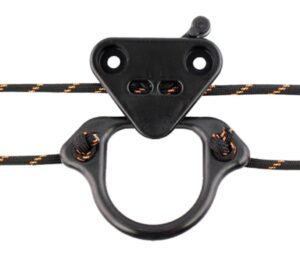
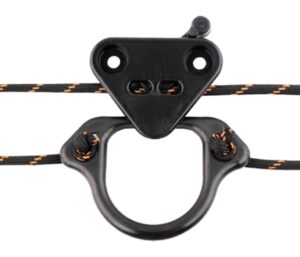
An anchor trolley is a loop of rope running along the side of the kayak through two pulleys. A ring is attached to it, and the anchor line runs through the ring. By pulling the loop you move the ring forward or back, while the anchor line stays in the same place on the bottom.
The principle is simple. The kayak always swings so that the anchor line's attachment point faces into the current or the wind. If the ring is moved forward, the kayak sits bow into the current. If the ring is moved back, the kayak sits stern into the current. If the ring is in the middle of the kayak by the cockpit, the kayak turns side-on.
In practice this means the following. A kayak sitting bow into the current is the most stable and offers the least resistance to the water, which is why you anchor this way in current and strong wind. A kayak turned side-on is more comfortable to cast from, because the whole stretch opens up in front of you, but you should only do this on calm water with no current. The trolley lets you switch from one position to the other in seconds without lifting the anchor.
In our range the anchor trolleys are the YakAttack LeverLoc and the stronger version, the YakAttack LeverLoc HD, priced from 59 to 69 EUR. Both kits include 10.7 m of 550 paracord with a reflective thread and a LeverLoc lever cleat that locks the line without a knot. The HD version adds backing plates under the pulleys and the cleat, which spread the load and prevent the hull from deforming, plus two extra PadHook guides. In practice this means the HD is built for higher pull, so choose it for current and a heavier anchor.
Safety: why anchoring in current can end in a capsize
Read this part before your first time anchoring on a river. Capsizing at anchor is one of those kayak fishing situations that end in death, and the mechanism is always the same.
When the anchor line is tied to the stern or the side of the kayak and the kayak sits in current, the water presses against the whole side of the hull. The current pushes water under one side of the kayak and forces the opposite gunwale down to the water. From that moment the kayak is no longer floating but acting as an obstacle in the river. The capsize happens in a second or two, with no warning, and often you do not even have time to understand what happened. The worst part comes next: the capsized kayak stays tied to the bottom, and the person is left in the current next to a taut line.
That is why three rules apply, with no exceptions.
- In current, anchor only from the bow or the stern, never from the side. The trolley ring must be pushed all the way to one end of the kayak.
- A quick-release mechanism is mandatory. This can be a cleat you release with one hand, or a carabiner with a release loop. You must be able to disconnect from the anchor in one motion, without looking and with one hand.
- A knife on your life vest. If the cleat jams, you cut the line. The knife must hang on the chest of your life vest, not in a crate behind your back.
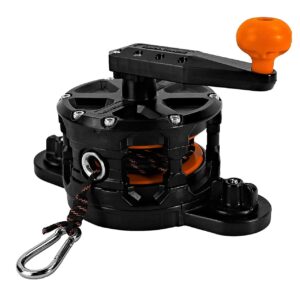
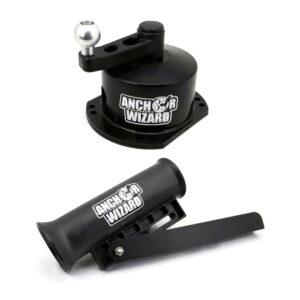
Reel systems such as the YakAttack DropShot anchor reel and Anchor Wizard anchor systemhave an advantage here, because they raise the anchor by turning a handle, and you do not need to haul the line over the side by hand. But they do not replace a quick release either. The reel must be connected to the kayak in a way that lets you release the whole line.
We wrote more about safety on the water in our self-rescue technique guide. You will find life vests in the safety category.
What anchor weight you need
The most common beginner mistake is an anchor that is too light. A folding grapnel anchor holds not by weight but by its flukes, which dig into the bottom, so the bottom type matters too.
- Mud, sand, gravel. A grapnel anchor bites well. On a calm lake 0.7 kg is enough, while on a windy day you need one twice as heavy.
- Hard clay and bare rock. The flukes do not dig in. You need a heavier one, around the 2.7 kg class, or better to change spots.
- Weeds and sunken wood. A grapnel anchor can snag so badly that it will not come free. Here a stakeout pole or a short stop tied to the weed edge works better.
The second thing is the line length. An anchor only holds when the line runs almost horizontally along the bottom, not straight down. The practical rule for calm water is at least three times the depth in line, and in current and wind at least five. This means that at five meters deep you need at least fifteen meters of line, and in current twenty-five.
In our range the folding grapnel anchor is the Galaxy Kayaks Folding Anchor 700 g with a 30 m line. This kit suits lakes and calm ponds. It is too light for a river.
Installation: what screws on and what clips on
An anchor trolley is mounted on the side of the kayak. There are two ways.
If the kayak has factory tracks, the end points of the trolley clip onto the track via a base and nothing needs drilling. Factory tracks come on the NuCanoe Flint, NuCanoe U10, Wilderness Systems A.T.A.K. 120 with GearTrac tracks and on Bonafide models. Bases that clip onto the track are the YakAttack LockNLoad track base and Complete LockNLoad mounting base, priced from 20 to 29 EUR.
If there are no tracks, the points are bolted through the hull. Then you need stainless steel bolts, wide washers on the inside and sealing with marine sealant. A hole in the side of a kayak is permanent, so before drilling it is worth sitting in the kayak and checking that your hand can actually reach the trolley loop from the seated position.
For the Anchor Wizard system on NuCanoe kayaks there are ready-made brackets that save you drilling: bracket for Flint kayaks and bracket for U10 and Unlimited kayaks, priced from 31 to 39.99 EUR.
The cheapest anchoring accessory is the kayak anchor line cleat for 6 EUR. It lets you fix the line at the length you want without a knot. We wrote a broader explanation of mounting with tracks and bases in our accessory mounting guide.
What to choose for a beginner and for a serious angler
For a beginner on a lake. A folding 0.7 kg anchor with a 30 m line and a cleat. A total of 6 to 69 EUR and no drilling. If you fish from the same kayak often, add a trolley after the season.
For an angler who already knows what they want. A LeverLoc or LeverLoc HD anchor trolley plus a heavier anchor. The trolley is the accessory nobody gives up once they have tried it, because it lets you change the kayak's direction without lifting the anchor.
For river and lagoon anglers. Choose the YakAttack DropShot reel. It mounts on a track, has an adjustable drag and an anti-reverse lock, and comes with 15.2 m of marine rope. The anchor goes down and up with one hand, so the other stays on the rod. It costs more than the whole beginner kit, so it is worth it when you raise the anchor dozens of times per trip. If you rarely anchor, a LeverLoc HD trolley will be enough.
For anyone who wants a reel, but not right away. Choose the Anchor Wizard. It works on a different principle from a trolley, because the anchor is lowered and raised with a handle and you do not need to haul the line over the side. You can buy the system in parts, since the 6 lb (about 2.72 kg) Radius anchor and the line guide are sold separately, so you can start with the cheapest part. NuCanoe owners have ready-made brackets, so no drilling is needed. If the reel principle suits you but the DropShot is too expensive, this is your option.
In short
An anchor on a kayak solves one problem and creates another. It lets you stay in place, but tied incorrectly in current it can capsize the kayak. If you remember one thing from this whole guide, let it be this: in current, anchor only from the kayak's stern or bow, and always through a mechanism you can release with one hand.
Prices and stock in this article are taken straight from the store, but you can always see an item's exact availability on the product page. Some YakAttack products are made to order, so it is worth confirming the lead time before planning your season.
The full YakAttack range is YakAttack brand page, and other kayak accessories in the accessories category. If you are just starting to set up a kayak for fishing, begin with the rigging guide.
Recommended products
The most popular products in this category