In just a few years the stand up paddle board (SUP) has become one of the most popular summer activities in Lithuania. And for good reason. An inflatable paddle board fits in a backpack, is ready in ten minutes and lets you paddle anywhere from the Trakai lakes to the Curonian Lagoon. But before you jump on the first deal you see, it is worth understanding a few things. In this guide we explain how to choose the paddle board that is right for you.
Why inflatable?
Inflatable paddle boards dominate the market, and there is a reason. Modern inflatable boards made from double PVC with drop-stitch technology are impressively stiff. And the advantages are obvious.
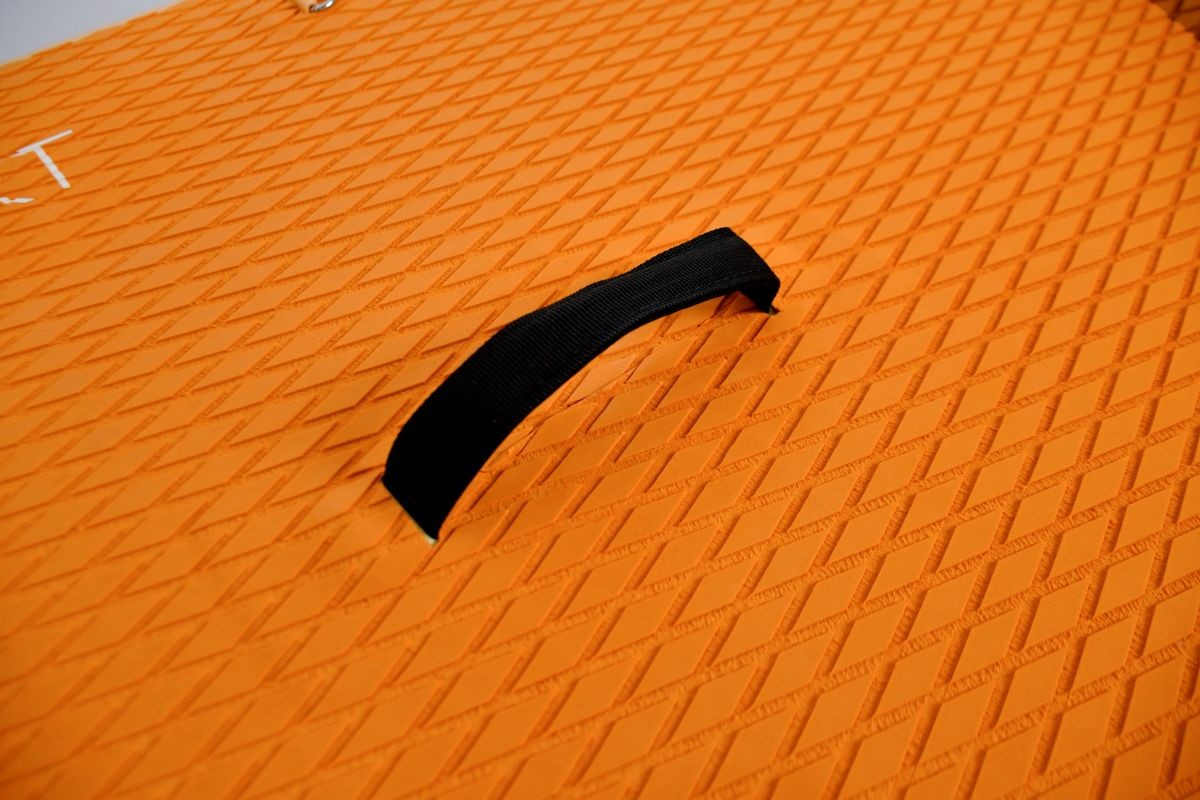
First, transport. An inflatable board fits in a backpack you can carry on your back, throw in the car trunk or even take on a plane. No roof rack, trailer or garage needed.
Second, storage. Let the air out, fold it up and put it in a closet. Live in an apartment without a garage? No problem.
Third, safety. An inflatable board is softer, so there is a lower risk of injury for beginners and children.
Paddle board types: which to choose?
Not all paddle boards are the same. Depending on what you plan to do on the water, choose the right type.
All-round
This is the most popular type and the best choice if you are buying your first paddle board. All-round boards are stable, easy to handle and suitable almost everywhere: on a lake, a river, even in a light sea swell. They are slightly wider and shorter than touring models, so they are easier to stay on.
Our recommendations: Amber ACE 10.0 V2, JBAY.ZONE Delta D2, WildSup Black Moose 10.6.
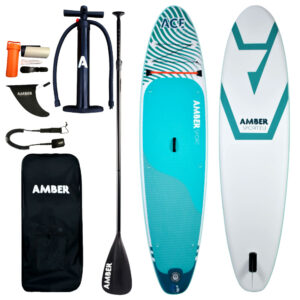
Touring
Longer, narrower boards made for longer distances. They are faster on a straight course and track better. If you plan regular trips on lakes or rivers, a touring board will pay for itself in the first summer.
Our recommendations: Amber PRIME 12.6 V2, JBAY.ZONE Comet J3, NRS Tour-Lite.
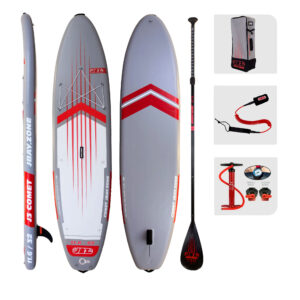
Fishing
Wider and more stable, with mounting points for rods. Some have a seat, so you can also paddle sitting down. The ideal option for anyone who wants to combine paddling with fishing.
Our recommendations: JBAY.ZONE Kame KX260 (with seat), NRS Heron.
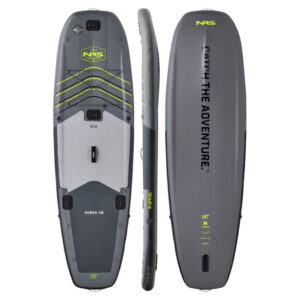
Tandem
Large boards that fit two people. A great choice for families or couples who want to paddle together.
Our recommendation: WildSup Kangaroo Tandem 12.9.
How to choose the size by weight
Size is the most important comfort factor. A board that is too small will be unstable, one that is too big will be hard to handle. The basic rule is simple: the heavier the paddler, the longer and wider the board needs to be.
| Paddler weight | Recommended length | Example models |
|---|---|---|
| Up to 75 kg | 10'0"–10'6" (305–320 cm) | Amber ACE 10.0, JBAY Delta D2 |
| 75-90 kg | 10'6"–11'0" (320–335 cm) | Amber COLT 10.6, JBAY Kame K260, NRS Revel |
| Over 90 kg | 11'5"–12'6" (350–381 cm) | Amber FACTOR 11.5, JBAY Comet J3, NRS Clipper |
| For children (up to 50 kg) | 9'0"–10'0" (275–305 cm) | Amber BSB 9.4 |
Width matters too. A board 30 inches (76 cm) wide or more will be more stable for beginners. A 32-inch (81 cm) wide board is an all-round choice for most paddlers.
Construction: how do cheaper boards differ from more expensive ones?
Price does not always mean quality, but the construction differences are real.
Single-layer boards are lighter and cheaper. They are great for calm paddling on a lake, but less resistant to impact. The Amber BSB and Amber ACE Lite models fall into this category.
Double-layer (double layer / fusion) boards are stiffer, more durable and hold pressure better. They feel remarkably solid underfoot. JBAY.ZONE, WildSup and NRS models use this technology.
Pressure (PSI) also matters. Standard boards are inflated to 15 PSI. Premium models (NRS, WildSup) take 20 to 25 PSI. Higher pressure means a stiffer board and a better paddling feel.
What is in the set: what you should get
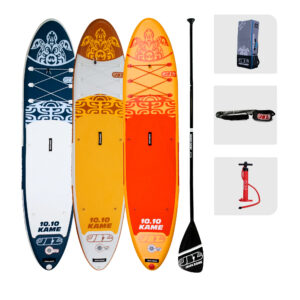
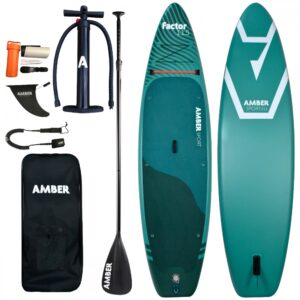
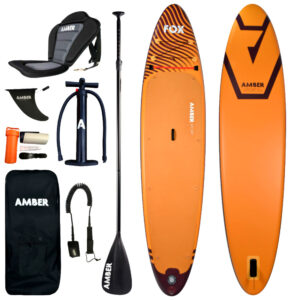
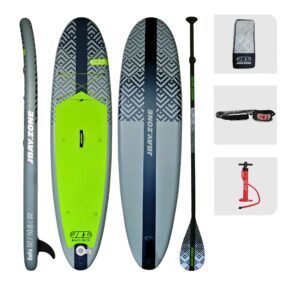
A good paddle board set should include everything you need for your first outing: the board itself, an adjustable paddle (aluminum or fiberglass), a high-pressure pump, a transport backpack and a safety leash. All VAKA Sport sets include these.
Pay attention to the paddle. Aluminum paddles are cheaper but heavier. Fiberglass or carbon fiber paddles are lighter and tire your arms less on longer routes. If you plan to paddle regularly, it is worth investing in a better irklą irklentei separately.
How much does it cost and what do you get for the price?
VAKA Sport offers paddle boards from 139 to 1,399 EUR. Here is what you can expect in each price group:
Up to 250 EUR (Amber BSB, ACE Lite, COLT Lite): for beginners, single-layer construction, everything in the set. A great choice if you want to try SUP without a big budget.
250–500 EUR (Amber ACE V2, COLT V2, JBAY Delta, JBAY Comet): mid-range, double layer, better paddles. Suits regular paddling too.
500–900 EUR (JBAY Rush, WildSup Black Moose, NRS Clipper, NRS Tour-Lite): premium class, top-quality materials, up to 20+ PSI. Made for experienced paddlers and those who paddle often.
Over 900 EUR (WildSup Royal Panda, King Lion, NRS Heron, Clean, Jukdo): professional class. Excellent construction, the lightest materials, specialized models (fishing, touring, tandem).
Frequently asked questions
Is an inflatable paddle board suitable for beginners?
Yes, an inflatable paddle board is the best choice for beginners. It is stable, safe (a softer surface) and easy to transport.
How long does it take to inflate a paddle board?
With the hand pump included in every set, you can inflate a paddle board in 5 to 10 minutes. If you want it faster, you can buy an electric pump.
Can an inflatable paddle board puncture?
Modern inflatable paddle boards are very tough. PVC with drop-stitch technology withstands contact with rocks, branches and sand. Of course, sharp glass or metal can damage any board, but that is very rare. Every set includes a repair kit.
What warranty does VAKA Sport give?
VAKA Sport gives a 2-year warranty on all paddle boards. That is one of the longest warranty periods in Lithuania.
Can you paddle on the sea?
Yes, but choose calm weather and avoid strong wind. All-round and touring boards suit the Baltic coast in calm weather. Always use a safety leash.
How does a SUP paddle board differ from a kayak?
On a paddle board you stand and paddle with a single-blade paddle; in a kayak you sit and use a double-blade paddle. A paddle board is more compact, more versatile and easier to transport. A kayak is faster and more stable in stronger wind. We write more about this in our article on the differences between a kayak and a paddle board.
Read also
- Best inflatable paddle boards 2026: JBAY.ZONE, Amber, WildSup and NRS compared
- Where to paddleboard in Lithuania: the best spots and routes
- SUP board or kayak: which should you choose?
Browse the full range of inflatable paddle boards or contact us by email at [email protected] and we will help you pick a paddle board to suit your needs and budget.
Recommended products
The most popular products in this category