
The inflatable paddle board market in 2026 is bigger than ever. Prices range from 200 to 1500 EUR, and picking from dozens of models without experience is hard. Here is a clear guide by purpose, skill level and budget, so you do not have to learn from mistakes.
In short: for your first board, choose an all round board 305 to 335 cm long and 80 to 86 cm wide, with a load capacity at least 30 to 40 kg above your body weight. Touring boards suit long routes, and wider fishing boards suit anglers. If you will paddle at least once a week, choose a Fusion or double layer construction.
| Your weight | Board length | Board width |
|---|---|---|
| Up to 70 kg | 305 cm | 76 to 80 cm |
| 70 to 90 kg | 320 to 335 cm | 80 to 84 cm |
| Over 90 kg | 335 to 365 cm | 84 to 86 cm |
How to choose a board by purpose
The first and most important question: what will you use the board for? Different uses call for different shapes, lengths and features. Versatile paddle boards exist, but there is always a compromise.
All round boards
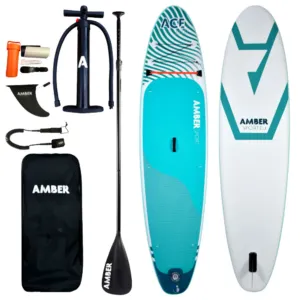
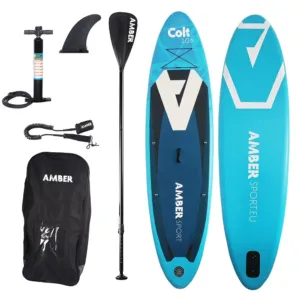
This is the most popular category and the best choice for beginners. An all round board is wide enough (80 to 86 cm) to be stable and long enough (305 to 335 cm) to glide without much effort. You can paddle it on calm lakes and rivers, and even try yoga or fishing.
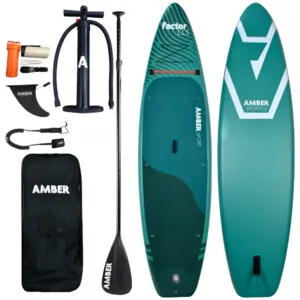
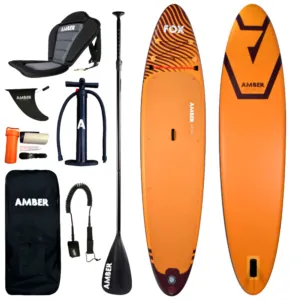
In our shop you will find a wide range of inflatable paddle boards from entry level to professional. Amber boards are a great choice for the Lithuanian market with good value for money. If you are looking for a reliable all round option, we also recommend checking out the NRS series, known for high build quality and durability.
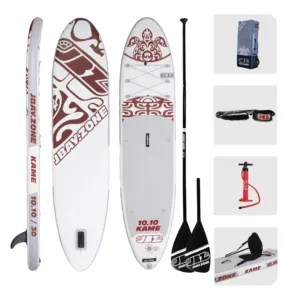
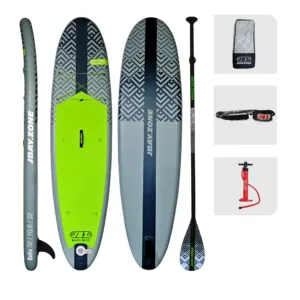
A new Italian alternative: JBAY.ZONE boards from Milan offer a heat welded rail and a full set from 199 EUR. It is one of the best value options on the market for beginners. We wrote more about this brand in our JBAY.ZONE paddle board guide.
Read more about choosing in our article The best SUP boards for beginners.
All round paddle boards for beginners
Touring boards
Touring boards are narrower (74 to 80 cm) and longer (335 to 380 cm) than all round boards. They have a pointed nose and a shape built for speed and tracking straight. They are the choice for anyone planning longer routes on Lithuanian rivers or lakes.
A touring board is not the best choice for your first board. It is less stable than an all round board, and a beginner may feel unsteady. But if you already have some experience and want to paddle 10 to 20 km routes, a touring board lets you go faster and with less fatigue.
Touring boards
Fishing boards
Fishing boards are the widest (84 to 90 cm) and most stable. They often have D rings for securing gear, rod holders and more deck space. Some have Scotty or Railblaza mounting points.
If you are seriously considering a fishing board, first read our SUP fishing guide, with recommendations by fishing style and budget.
SUP boards for fishing
Yoga and fitness boards
Yoga boards are wide (84 to 90 cm), with soft EVA padding along the whole length and a non slip surface. They are built for stability when standing, kneeling or holding poses. Most have a flat deck without a textured pattern so they are comfortable to lie on.
We wrote more about training on the water in the article SUP yoga and fitness.
What do paddle board specs mean?
Length. Shorter boards (up to 305 cm) are more manoeuvrable but slower. Longer ones (335+ cm) glide better and hold their line, but are harder to turn in tight spots. The all purpose size for most adults: 320 to 335 cm.
Width. The wider the board, the more stable but slower it is. 80 to 84 cm suits most people. Lighter paddlers (up to 75 kg) can go narrower, while heavier paddlers (over 90 kg) should choose 84+ cm.
Thickness. Most quality boards are 12 to 15 cm thick. Thinner ones (10 to 12 cm) are lighter but carry less weight. 15 cm is the standard, giving good stiffness and a load capacity of up to 120 to 150 kg.
Load capacity. This is the maximum weight the board can carry without losing stability. Always choose a board with a load capacity at least 30 to 40 kg above your own weight. That leaves room for a backpack, a cooler or a pet.
Number of layers and technology. Single layer boards are cheaper but less stiff. Fusion and Double layer technologies give more stiffness and durability. The top class is Woven Drop Stitch, where the woven structure increases stiffness by 20 to 30% compared with standard Drop Stitch.
Which paddle board brands do we recommend?
Amber. A Lithuanian brand with good value for money. Suits beginners and intermediate paddlers. We wrote more about them in our Amber SUP guide.
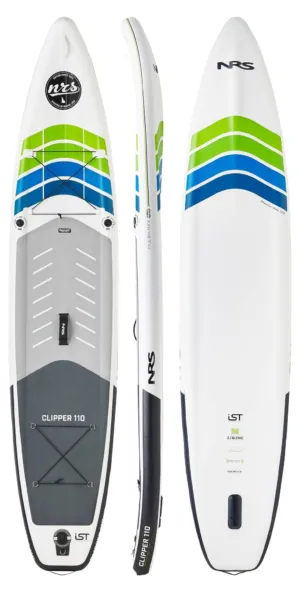
NRS. An American brand known for durability and quality. NRS boards use Woven Drop Stitch technology, which gives them exceptional stiffness. It is an investment for the long term. You will find more information in our NRS paddle board review.
JBAY.ZONE. Italian boards from Milan with a heat welded rail and 2LF Fusion technology. From the entry level Kame line (199 EUR) to the advanced Comet with a fibreglass paddle (399 EUR). Five models in total, each with a complete set. You will find more information in our JBAY.ZONE paddle board review.
How much does a good paddle board cost?
200 to 400 EUR: entry level. Single layer construction, basic set (paddle, pump, backpack). Good for occasional use and getting to know the sport. Usually lower load capacity and stiffness.
In this segment it is especially worth looking at JBAY.ZONE paddle boards: the Kame K260 (199 EUR) with a heat welded rail, the Delta D2/D3 (289 to 329 EUR) and the Comet J3 (399 EUR) with 2LF Dual Layer Fusion construction and a fibreglass paddle.
400 to 700 EUR: mid range. Fusion or Double layer construction, a better paddle and pump. Good for regular use 2 to 3 times a week. This is the segment where most people find the best value.
700 to 1200 EUR: premium. Woven Drop Stitch or similar top class construction. Carbon paddle, high pressure pump, premium backpack. Made for regular paddlers who want the best quality and durability.
1200+ EUR: professional level. Race boards and specialised models. Made for enthusiasts and athletes.
Our recommendation: if you plan to paddle at least once a week, invest in a mid range board (400 to 700 EUR). It will last several seasons and give you a far better experience than the cheapest option.
What do you need to know about care?
An inflatable paddle board needs very little care, but a few things will extend its life:
- Rinse with fresh water after every use , especially after the sea or salt water. Salt damages the PVC and seams.
- Dry it before rolling it up . A wet board in a backpack means mould and a bad smell.
- Keep it out of direct sunlight . UV weakens PVC over time. If you are at the beach, let a little air out when you are not on the water.
- Protect it from sharp objects : rocks, glass, fishing hooks. Most boards come with a repair kit, but prevention is better than repair.
You will find more practical tips in our guide to preparing for your first trip.
Safety on the water
Even on a paddle board we recommend wearing life jacket, especially when paddling far from shore or on moving water. Lightweight WALLYS buoyancy aids do not restrict movement and are made for paddling. Read more: life jacket comparison.
Frequently asked questions
Is an inflatable board stiff enough?
Yes, as long as it is inflated to the recommended pressure. Premium models with Woven Drop Stitch technology are pumped to 20 to 25 PSI and barely flex underfoot. An inflatable board also fits in a backpack, so it is easy to carry in a car boot and store in a flat.
What size board should you choose for your weight and height?
Up to 70 kg: 305 cm long, 76 to 80 cm wide. 70 to 90 kg: 320 to 335 cm long, 80 to 84 cm wide. Over 90 kg: 335 to 365 cm long, 84 to 86 cm wide. Height matters less than weight, but taller people (over 185 cm) will find a longer board more comfortable because of the paddle angle.
How long does an inflatable paddle board last?
It depends on quality and care. Entry level boards (200 to 400 EUR) last 2 to 4 seasons. Mid range boards (400 to 700 EUR) last 4 to 6 seasons. Premium boards (700+ EUR) can last 6 to 10 years or more if properly cared for. The main enemies: long exposure to UV, poor storage (wet, rolled up in a hot garage) and mechanical damage.
Read also
- Best inflatable paddle boards 2026: JBAY.ZONE, Amber, WildSup and NRS compared
- How to choose an inflatable SUP board: a beginner's guide (2026)
- WildSup paddle boards: a guide to Lithuanian-designed SUPs
Recommended products
The most popular products in this category