
Your first trip on the water is always exciting. Whether it is a day paddle on a lake or a weekend on a river with an overnight stay, good preparation is the difference between great memories and nasty surprises. Here is a concrete list: what to take, what to check and what not to do.
What should you check before the trip?
The weather forecast. This is the first thing to check. Strong wind (over 5 m/s) whips up waves on lakes that can be dangerous for beginners. Rain on its own is not a problem, but a thunderstorm is a serious danger on the water. If a storm is forecast, it is better to postpone the trip.
The route. Know exactly where you will put in and where you will take out. On longer rivers, plan stops along the way. Check for dams, bridges or other obstacles you may have to portage around.
Water level. This matters especially on rivers. When the water is too low there will be lots of shallows and you will have to wade. When it is too high the current is stronger and can be dangerous. You can check water levels on the hydrometeorological service website.
Tell someone. Let a family member or friend know where you will paddle and when you plan to be back. It is a simple rule that can help in an emergency.
What gear should you take on a day trip?
A day paddle does not need much, but a few things are essential:
Essential:
- A life jacket : not next to you but ON you. Under Lithuanian law it is mandatory on all open waters
- A paddle (and check it is the right length for you)
- Water: at least 1.5 litres per person. You dehydrate quickly on the water, even if you do not feel thirsty
- A phone in a waterproof case or dry bag
Highly recommended:
- Sun protection: sunglasses (with a strap!), a hat, SPF 30+ sunscreen
- Suitable clothing : light sportswear in summer, layers in spring and autumn
- A dry change of clothes in a dry bag (in case you get wet)
- A light snack (energy bar, fruit, nuts)
- Car keys in a waterproof case (not in your pocket!)
Not essential, but handy:
- A camping chair or mat if you plan a longer break on the shore
- A camera or action camera (with a kayak mount)
- A small cooler for drinks (fits between your legs on a sit on top kayak)
What extra should you take for an overnight trip?
An overnight trip needs more planning and gear. Add to the day trip list:
- A tent (compact, light, rainproof)
- A sleeping bag (to suit the season: +10°C is enough in summer, +5°C in spring and autumn)
- A sleeping mat
- A camping stove and pot
- Food for two days (allow 2500 to 3000 kcal a day for active paddling)
- Water or a water filter (3+ litres a day)
- A torch (waterproof)
- A first aid kit
- Mosquito and tick repellent
- A rubbish bag (take out everything you bring in)
Pack all your gear in dry bags. Even if you do not plan to capsize, rain or waves can soak your things.
Read more about trip planning and routes in our guide Kayak touring.
What not to do the first time
A few mistakes almost every beginner makes:
- Do not paddle alone. Your first trip should always be with a friend or a group. Even experienced paddlers try not to go alone in unfamiliar places.
- Do not overdo the distance. For beginners 10 to 15 km a day is plenty. It does not sound like much, but with stops and breaks it will take 4 to 6 hours.
- Do not ignore the wind. Wind is a beginner's biggest enemy, especially on lakes. A 5 m/s wind creates waves that can capsize an inexperienced paddler.
- Do not leave your life jacket in the kayak. It has to be on you, not next to you. If you capsize there will be no time to look for it.
- Do not forget sun protection. On the water the sun hits twice as hard because of the reflection. Four hours without sunscreen can leave you badly burnt.
Read more about the most common mistakes in the article 5 most common beginner mistakes.
Which kayak is right for your first time?
If you do not have your own kayak yet and are wondering where to start:
- Calm lake, one day: bet koks sit-on-top recreational kayak. Kuo platesnis, tuo stabilesnis. VAKA Sport Uno, Galaxy Pinguino, Fuego or Blaze XL are reliable choices.
- River, one day: a sit on top kayak at least 280 cm long. Shorter models are more manoeuvrable but slower.
- Overnight trip: a longer kayak (350+ cm) with storage space. Wilderness Systems PUNGO 120 or the Galaxy range with storage compartments.
- Not ready to invest straight away: an inflatable kayak is a cheaper and more compact choice for a first experience.
You will find the full buying guide in How to choose your first kayak.
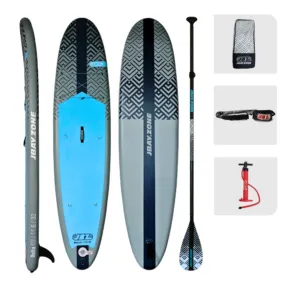
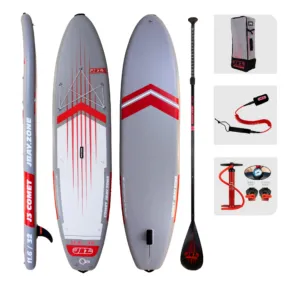
If you do not have your own paddle board yet, we recommend the JBAY.ZONE Kame K260 . It is one of the most affordable quality boards on the market (199 EUR with a full set), and you can get on the water straight away with no extra purchases.
Safety on the water
Even on a paddle boards we recommend wearing a life jacket, especially when paddling far from shore or on moving water. Lightweight WALLYS buoyancy aids do not restrict movement and are made for paddling. Read more: life jacket comparison.
Frequently asked questions
Do you need to be able to swim to go kayaking?
Formally no, but being able to swim is strongly recommended. A life jacket will keep you afloat even if you cannot swim, but knowing how to swim gives you confidence and a sense of safety. If you cannot swim, choose calm, shallow waters and always wear a life jacket.
When is the best time to start?
June and July are the best months for beginners: warm air, warm water and long days. May and August work too, but the water can be cooler. For your first time avoid April and September, when the water is cold and the risk of hypothermia is higher.
How much does it cost to start kayaking?
Minimum budget with your own kayak: a recreational kayak from 250 EUR, a paddle from 30 EUR, a life jacket from 25 EUR, a dry bag from 15 EUR. About 320 EUR in total. It is a one off investment that lasts many seasons. For comparison, renting a canoe for a day with transport costs 40 to 70 EUR.
Read also
- Where to kayak in Lithuania: the best routes and places (2026)
- The 5 most common beginner mistakes when kayaking
- Kayak transport and storage: the complete guide
Recommended products
The most popular products in this category