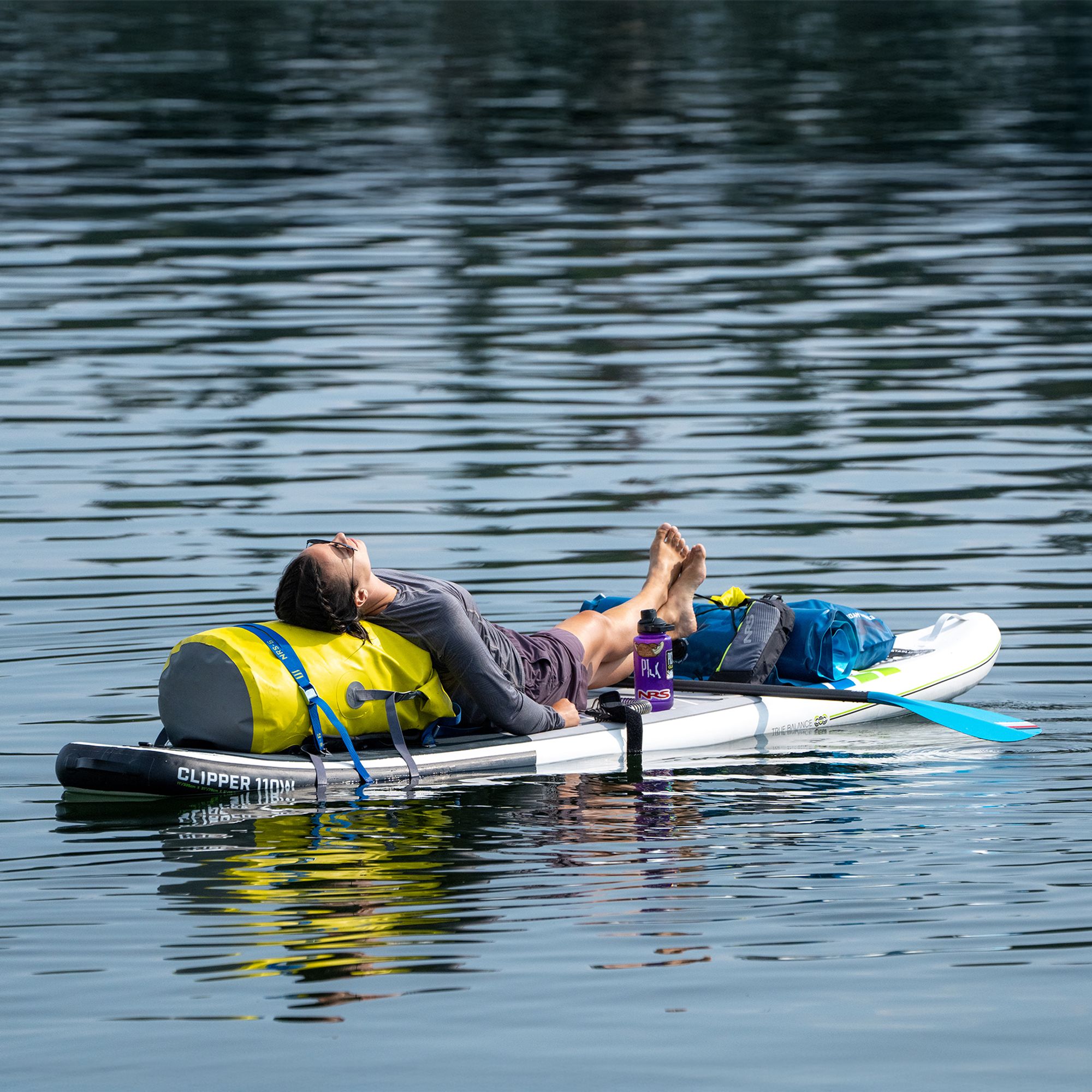
A SUP board is not just a way of getting around on the water. In recent years it has become one of the most popular fitness platforms in the world. SUP yoga, SUP Pilates and SUP fitness are the three fastest growing disciplines. The reason is simple: water adds instability, which makes you work deeper muscles than any workout on solid ground.
Read also: SUP paddling technique, How to choose a paddle board.
Why train on a paddle board?
Paddling a SUP is a good workout in itself. In an hour of easy paddling you burn around 300 to 450 kcal, and up to 700 kcal when paddling hard. But once you start doing yoga poses or fitness exercises on a paddle boards the intensity goes up to a whole new level.
The water is always moving beneath you. Even a calm lake has small ripples that make your body constantly adjust its balance. That means even simply standing on a board engages core muscles that usually rest on solid ground.
A study published in the Journal of Sports Science and Medicine found that exercising on an unstable water surface engages 20 to 30% more muscle groups than the same exercises on solid ground. This matters especially for the deep stabilising muscles that are hard to reach with traditional training.
What is SUP yoga?
SUP yoga is yoga practised on a paddle board. The main poses are adapted to the water: you start with seated and lying poses, and experienced practitioners move on to standing and balance poses.
The best poses for beginners on a board:
- Child's pose (Balasana) : kneel on the board and fold forward. The easiest pose and a great place to start
- Cat cow (Marjaryasana) : on all fours on the board, arching up and down. Builds spinal flexibility
- Warrior I (Virabhadrasana I) : one leg bent in front, the other straight. A great balance pose
- Downward dog (Adho Mukha Svanasana) : a classic yoga pose that needs extra stability on a board
For advanced practitioners:
- Tree pose (Vrksasana) : standing on one leg on the board. A serious balance challenge
- Warrior III (Virabhadrasana III) : standing on one leg with your body horizontal. One of the hardest
- Headstand (Sirsasana) : only for the very experienced. On water it is a completely different challenge
SUP fitness: which exercises work best?
If yoga is not your thing, you can do many traditional fitness exercises on a board. The water makes them far more effective:
- Push ups : on an unstable surface they work your shoulders and core much harder
- Plank : 30 seconds on a board is worth a minute on the floor. Your core works the whole time
- Squats : the board rocks on the ripples, so you need much more stability
- Lunges : great for balance and leg muscles
- Burpees : on a board this is an extreme exercise, only for the very fit
Start with 20 to 30 minute sessions and build up gradually. In your first few sessions you will probably fall in a few times. That is normal and part of the process.
Which board is right for yoga and fitness?
Not every board is good for training. The main criteria:
Width. The wider the board, the more stable it is. For yoga and fitness a width of 82 to 86 cm (32 to 34 inches) is recommended. Narrower boards (76 to 80 cm) are faster but harder to exercise on.
Length. A mid length board of 305 to 335 cm (10 to 11 feet) is ideal. Too short will be too unstable, too long will be too hard to manoeuvre.
Deck pad. For yoga it is important that the deck is soft and non slip across the whole board. Some boards have a wider deck pad that covers almost the entire surface. That is ideal for exercising.
Thickness and stiffness. A 15 cm (6 inch) thick board inflated to high pressure (15 to 20 PSI) is stiff enough for dynamic exercises without feeling the surface flex.
From our range, the best boards for yoga and fitness are the wider Amber PRO series boards and NRS models with a wide deck pad. Read more about choosing a board in our SUP board buying guide.
Wider all round models such as the JBAY.ZONE Delta D3 (350 cm, 81 cm wide) or the JBAY.ZONE Comet J3 (350 cm, 81 cm wide, 338 L volume) also work well for fitness on the water thanks to their good stability and roomy deck.
Where can you train on a paddle board in Lithuania?
Yoga and fitness need calm water with no waves or current. The best options:
- Small lakes with no motorboats : calm water and no wake from other boats
- River backwaters : calm water next to the river, with no current
- Early morning : from 6 to 9 am the surface of most waters is completely calm
You will find more spots in our guide Where to paddle board in Lithuania.
Frequently asked questions
Safety on the water
Even on a paddle board we recommend wearing life jacket, especially when paddling far from shore or on moving water. Lightweight WALLYS buoyancy aids do not restrict movement and are made for paddling. Read more: life jacket comparison.
Do you need yoga experience to start SUP yoga?
No, but you should know the basic yoga poses. If you have never done yoga, we recommend a few classes on solid ground first so you understand how the poses work. Then take them onto the water. The water adds a balance challenge, so every pose is harder on a board than on a mat.
Is SUP fitness really more effective than a gym workout?
It is more effective for specific muscle groups: core stabilisers, deep back and abdominal muscles, and balance. But it is not a full replacement for strength training with weights. SUP fitness works best as an extra session that trains what the gym cannot reach.
Can you train on a cheap board?
You can, but the experience will be worse. Cheaper boards (under 200 EUR) are often narrower, thinner and less stable. They flex underfoot when you exercise. A mid range board (300 to 500 EUR) that is 15 cm thick and 82+ cm wide will give you enough stability and stiffness for proper training.
Recommended products
The most popular products in this category