Standing on a paddle boards and paddling looks easier than it really is. Many beginners make the same mistakes: they hold the paddle the wrong way, paddle with their arms only and are afraid to stand up straight. A few basic technique rules will help you paddle more efficiently, tire less and enjoy it more.
Read also: How to choose a paddle board, Best paddle boards 2026, Where to paddle board in Lithuania.
How do you hold a SUP paddle correctly?
The first and most common beginner mistake: the paddle blade should angle forward, not back. It feels counterintuitive, but that way the paddle grips the water better and pushes the board forward. If the paddle in your set is too heavy, a lighter irklą irklentei can be bought separately.
One hand holds the top of the paddle (the T grip), the other holds the shaft at about shoulder height. Your hands should be wide apart, roughly as for a push up. If your hands are too close together, you lose power and control.
Paddle length: standing on the ground, the paddle should reach 15 to 25 cm above your head. A paddle that is too short makes you bend over, one that is too long gets in the way of an efficient stroke. Most paddle board sets come with an adjustable paddle, so you can set it to your height.
How do you stand up on a paddle board?
Start on your knees. Wade in up to your knees, climb onto the board and kneel in the middle (at the carry handle). Paddle on your knees for a few minutes until you feel stable. Then stand up slowly: one foot, then the other, feet shoulder width apart, knees slightly bent.
Look at the horizon, not at your feet. Looking down makes your balance worse. When you feel unsteady, bend your knees more and lower your centre of gravity. That works better than waving your arms around.
Your feet should be parallel, right in the middle of the board (where the carry handle is). That is the widest and most stable part of the board. Wider beginner boards (32 to 34 inches wide) help a lot here, as they give you more stability.
How do you paddle forward properly?
The basic paddle stroke looks simple, but it has a few important details.
Put the paddle blade in the water in front of you as far as you can comfortably reach (without overstretching). The blade should be fully submerged. Then pull the paddle back along the edge of the board, parallel to it. Finish the stroke at your ankles and lift the paddle out of the water.
Most importantly, the power should come from your core and legs, not your arms. Imagine rotating your whole body rather than pulling the paddle with your arm. Your top hand pushes the paddle down, your bottom hand just holds it and steers. When you paddle correctly you feel it in your back and abs, not your biceps.
Switch sides every 4 to 6 strokes. This keeps you going straight and spreads the load evenly across your body. Beginners often paddle too long on one side and watch the board turn.
How do you turn a paddle board?
There are three main ways to turn:
Sweep stroke. Put the paddle in near the nose of the board and draw a wide arc all the way to the tail. Paddling on the left turns the board to the right. It is the simplest method and works for wide turns.
Back strokes. Paddle backwards on the side you want to turn towards. Want to turn left? Paddle backwards on the left. It is a quicker turn than the sweep stroke.
Pivot turn. Step back towards the tail of the board (one foot on the tail pad), the nose lifts out of the water and you can spin the board easily. It is the fastest turn but needs better balance. Worth learning later, once you feel confident.
What do you do when you fall in?
Falling in is normal. Everyone falls, even experienced paddlers. The key is to fall correctly: always fall to the side, into the water, not onto the board. Landing on the hard surface of the board can cause bruises or more serious injuries.
Once you are in, grab your paddle first (it floats). Then swim to the board, climb on from the side (not the tail) and start again from your knees. The leash connecting your ankle to the board stops it drifting away. Always use a leash, even on calm water.
What mistakes do beginners make most often?
Paddle blade the wrong way round. I have already mentioned it, but it bears repeating: the blade should angle forward. This is mistake number one.
Paddling with your arms only. Your arms will tire within 10 minutes. Use your core and legs. Check that you are rotating your body as you paddle.
Stance too narrow. Your feet should be shoulder width apart. Feet too close together mean less stability.
Looking at your feet. Look ahead, at the horizon. Your head is the heaviest part of your body: where it goes, the rest follows.
Paddling too far from the board. The paddle should travel parallel to the board, as close to the edge as possible. If you paddle far from the board, it will just turn on the spot.
Starting on a windy day. Pick a calm day for your first outing. Wind is a beginner's biggest enemy on a paddle board. Even a light breeze can push you further than you planned.
Frequently asked questions
How long does it take to learn to paddle a SUP?
Most people master basic paddling within 30 to 60 minutes. After 3 to 5 sessions you will feel confident enough to enjoy longer trips. Advanced technique (quick turns, paddling in waves, racing) takes months of practice.
Do you need to be able to swim to paddle board?
Being able to swim is recommended but not essential if you wear a life jacket and paddle on calm, shallow water. Still, knowing how to swim gives you confidence and safety. If you plan to paddle regularly, it helps to at least feel comfortable in the water.
What is the best paddle board for beginners?
Beginners should choose a wider (32 to 34 inches) and longer (10'6" to 11'6") inflatable paddle board. A wider board means more stability, a longer one tracks better. You will find a detailed comparison with specific models and prices in our beginner's guide.
Can you paddle on your knees the whole time?
Yes, and there is no shame in it. Kneeling is a perfectly normal paddling position, especially when the wind picks up, when you are tired or when you simply want to relax. Many experienced paddlers drop to their knees when conditions get worse.
The full range of inflatable paddle boards can be found in the VAKA Sport shop. If you are not sure which board would suit you, write to [email protected] and we will help you choose based on your height, weight and needs.
Related articles
- Best SUP boards for beginners 2026
- Where to paddle in Lithuania: the best spots
- Water sports clothing: what to wear on the water
- SUP fishing: how to fish from a paddle board
Recommended paddle boards
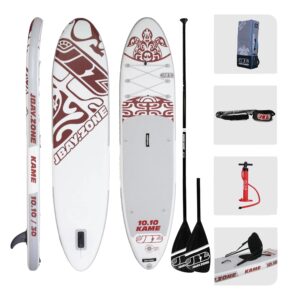
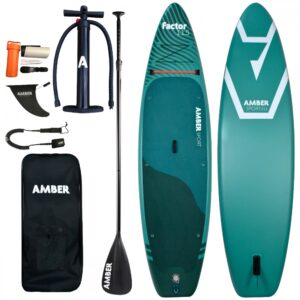
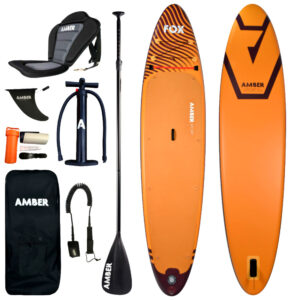
For beginners we recommend the Amber Factor 11.5 Lite (from 199 EUR) or the JBAY.ZONE Kame K260 (from 199 EUR). For experienced paddlers: Amber Fox 12.4 with seat.
Recommended products
The most popular products in this category